Solar energy/Resource availability
Introduction
The amount of sunlight that will strike the Earth's surface will depend on a few factors, some of which are periodic and others can be considered variable. Some periodic factors:
- Seasonal
- Day/night
- Urban shade
Some variable factors
- Cloud coverage
- Other natural weather events
In order to calculate the daily paths of the sun over the horizon across the year, several formulas and equations are first necessary to solve.
Latitude and longitude
In addition to the position of the planet around the sun, the amount of sunlight available at any point on the Earth's surface will also depend on the longitude and latitude of the geographic position. Latitude is a measure of how far north or south you are, and varies from -90° (90° south) to +90° (90° north). The longitude is a measure of how far east or west one is, and varies from -180° (180° west) to +180° (180° east).
True solar time
True solar time (TST) is used to convey the relative position of the sun compared to the earth, regardless of your position on earth. The following equation returns the true solar time in hours.

Equation of time
The equation of time can be approximated by a sum of two sine waves. The first method is precise, and the second method shown here is approximate.
Precise method
(minutes)

where:

where represents the number of days since 1 January of the current year, .


Rough approximation
For in minutes, see the following equation. Ensure that the trigonometry relations are calculated in radians mode.


Where B is:
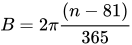
Where is the day of the year.

For in degrees, see the following equation. Ensure that the trigonometry relations are calculated in degrees mode.
Where J is:

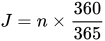
Where is the day of the year.
Note that some formulas result in positive answers, while other result in negative times. This is correct and refers to how early or late compared to true solar time the sun will be. For example, the sun can be as much as 14.29 minutes or 3.56 degrees slow (a positive amount) on February 11th (the 42nd day of the year), and as much as 16.40 minutes or -4.10 degrees fast (a negative amount) on November 3rd (307th day of the year).
Solar declination, δ
Throughout the annual orbit of the Earth around the Sun, the distance between the two bodies is around 150 million km. Because the Earth's orbit is elliptical, the actual distance between the Sun and the Earth will vary somewhat. The Earth takes around 365.25 days to completely orbit the Sun.
The solar declination, δ, is the angle at which the sun Earth is inclined relative the plane of orbit around the Sun. For the northern hemisphere, the angle of declination varies from +23.45 degrees in Winter to -23.45 degrees in Summer.
The solar declination angle can be calculated at any point of the year with the following equations:
Solar declination rough approximation, in degrees

Solar declination finer result, in radians

Solar declination finer result, in degrees

Where J is the day of the year, with January 1st being n=1.
, in degrees.

Half hour angle, ω₀
Calculate the hour angle when the altitude angle is equal to 0.

Using this equation, you can find true solar time (TST) at sunrise and at sunset.
, make sure that is in degrees.


, make sure that is in degrees.

In addition you can find day length, i.e. the time that the sun is above the horizon, using the half hour angle equation:
, make sure that is in degrees.
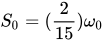
A quick check of the half hour angle and whether or not it is greater or less than can tell you if the day is shorter or longer than the night.

if: , then the day is longer than the night, and the time that the sun is in the sky is at least 12 hours.

if: , then the day is shorter than the night, and the time that the sun is in the sky is less than 12 hours.

Elevation angle, h
Imagine the sun is up and you are standing outside. Turn your body so that you facing the sun. Then point your arm directly towards the sun. The angle between the ground (the plane surface, if you are standing on a hill ignore the angle of the hill) and your arm is the elevation angle. The function for the angle of elevation in degrees is:
![{\displaystyle h=arcsin[cos(\delta -{Lat})]=90^{\circ }-Lat+\delta }](../_assets_/eb734a37dd21ce173a46342d1cc64c92/c5ef902b3f046af46140ff896d152ec28e6c55a4.svg)
Where is the angle of declination in degrees, is the latitude of the location under analysis in degrees.



Hour angle, HA
The hour angle (noted HA) is the conversion of true solar time (TST) to an angle. Where solar midnight is always 0:00am or 24:00 - or +180 degrees and true solar noon is always 12:00 and 0 degrees. The calculation of the half hour angle, HA is:
For HA in degrees:

For HA in radians:
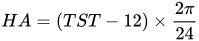
As can be deduced from the equations, the sun moves 15 degrees (360/24) in the ecliptic plane, no matter what day of the year it is.
This angle is measured by this type of sundial:

Azimuth angle, Az
The first step before calculating the azimuth angle is determining whether if the is positive or negative.

The equation for is the following equation. Ensure that the trigonometry functions are set to degrees mode for calculating , , and , if you converted the variables to degree form.


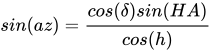
Where is solar declination in degrees, is half hour angle in degrees and is altitude angle in degrees.
if then use


if then use


Where is the latitude in degrees, is the solar declination angle in degrees, and is the altitude angle in degrees.
Note, that:
- if , then the Sun is still up above the horizon (polar summer in the northern hemisphere).

- if , then the Sun will not rise (polar winter in the northern hemisphere).

Method for calculating sun path chart
For true solar noon of a given day of the year
- Find of year (day # of year, with January 1st being .)
- Calculate solar declination angle in degrees.
- Calculate equation of time () in (minutes). Ensure that is converted to hours before the next step using the conversion ratio of 60 minutes per hour.
- For a select number of true solar times (), for example, 8am, 9am, 10am, ... 10pm, etc. calculate the coordinated universal time () and then the local time ().
- Calculate the hour angle for each of the true solar times under consideration.
- Calculate the altitude angle in degrees for each hour angle, .
- Calculate the to determine if the value is negative or positive.
- Based on the relative positivity or negativity of the , choose the correct azimuth () formula to use.


...