Analyzing the properties of seals leads to pairs of number hyperpyramids with axes arity/adicity, valency, depth and gravity.
overview of the hyperpyramids
The five tetrahedra shown below are for arity 6.
They are all symmetric. (See illustration.)
Horizontal rectangles with the same distance from the middle have the same entries.
Positions with the same entries are (v, d, g) and (a−g, a−d, a−v).
There are many ways to represent these hyperpyramids as series of pyramids. Three are chosen, and shown below for Wisteria.
The first two image types show a pyramid for each arity or adicity.
The one on the left makes it easy to see, that all entries in this hyperpyramid come from triangle Magnolia.
That in the middle makes the symmetry of the black entries easy to see. (Horizontal rectangles with the same distance from the middle correspond to each other.)
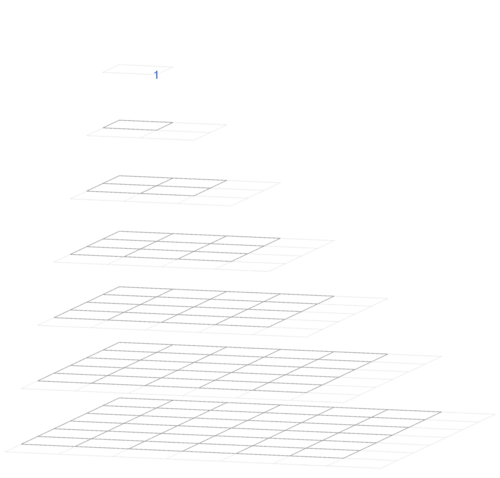
The image type on the right goes through the hyperpyramid by depth. (This image shows the entries of Magnolia as a square array in every horizontal rectangle.)
arity 6
arity 6
depth 3
The blue entries are those with valency = depth = gravity. They are always separated from the contiguous black entries.
Each seal has props a, v, d, g.
Each house contains an infinite number of seals, and has only props v, d, g.
Although a house does not have an adicity, each adicity can be assigned a number of houses:
The Dahlia(a) seals with adicity a belong to Heather(a) houses.
(Compare triangle pairs Oak and Elm.)
Each house has a room of finite size for each adicity ≥ valency.
The sum of these room sizes can be described as the house size for a given arity.
It follows (rather unelegantly) that the room size should be described as the "house size" for a given adicity.
(Hence the terms room and house are used almost synonymously here.)
The props (v, d, g) together shall be called a street. A street can contain multiple houses with different sizes.
Room sizes are bigger for higher adicities, but their ratio to each other remains the same.
Each street can be assigned a sequence of reduced house sizes, obtained by dividing room sizes for any adicity by their GCD.
The smallest room sizes are in SyringaDrop. The divisors are in CherryDrop. The sums of the reduced house sizes are in Plum.
Symmetry
For a given arity the seals and houses of opposite depths belong to pairs of antipodes.
This causes the symmetry of triangles Oak and Elm, and that of their refinements Jacaranda and Laburnum.
The three hyperpyramids related to house sizes are also symmetric.
symmetry in Wisteria
arity 0
arity 2
arity 4
arity 6
arity 1
arity 3
arity 5
arity 7
Hyperpyramids Jacaranda(Drop)
fixed a (triangles)
The sum of pyramid a in Jacaranda is Daisy(a).
The sum of layer v in that pyramid is Ash(a, v).
The sum of row d in that layer is Liana(a, d, v).
The sum of row g in that layer is TwistedLiana(a, d, g).
a = 0
🌊 Jacaranda arity 0
💧 JacarandaDrop adicity 0
a = 1
🌊 Jacaranda arity 1
💧 JacarandaDrop adicity 1
a = 2
🌊 Jacaranda arity 2
💧 JacarandaDrop adicity 2
a = 3
🌊 Jacaranda arity 3
💧 JacarandaDrop adicity 3
a = 4
🌊 Jacaranda arity 4
💧 JacarandaDrop adicity 4
a = 5
🌊 Jacaranda arity 5
💧 JacarandaDrop adicity 5
a = 6
🌊 Jacaranda arity 6
💧 JacarandaDrop adicity 6
a = 7
🌊 Jacaranda arity 7
💧 JacarandaDrop adicity 7
fixed a (rectangles)
The sum of pyramid a in Jacaranda is Daisy(a).
The sum of layer d in that pyramid is Oak(a, d).
The sum of row v in that layer is Liana(a, d, v).
The sum of row g in that layer is TwistedLiana(a, d, g).
All entries are from pyramid Quince. It is shown here as a hyperpyramid for convenience.
Below the pyramids of Cydonia are shown between those of Buddleja and Jacaranda. Buddleja(Drop) · Cydonia = Jacaranda(Drop)


.jpg)

.jpg)