Quantum A Matter Of Size
 |
Subject classification: this is a physics resource. |
Approach to Mesoscopic Physics: Quantum Size Effects
Objective
| Condensed matter physics |
|---|
 |
This article is based on Wikipedia articles and other sources as well as Wikiversity:Original research.The objective is to explain how "sizes" are used in Quantum Mechanics (QM). Often sizes in quantum mechanics are probabilistic, with particles not having a fixed size, but a size that depends on factors like wavelength or boundary condition.
Mesoscopic physics is a field within condensed matter physics that describes systems whose dimensions are intermediate between the nanoscale of individual atoms or molecules and the micrometre scale of bulk materials.[1] Systems large enough to contain many atoms, yet still small enough so that the motion of particles is influenced by quantum mechanical effects rather than being fully described by classical physics.[2][3]
An electronic device miniaturized from macroscopic to mesoscopic dimensions (see also Carlo Beenakker) behaves differently as a consequence of quantum coherence. Macroscopic wire shows a smooth increase in electrical conductance with thickness, but a wire at mesoscopic scale exhibits quantized conductance, increasing in discrete steps rather than continuously. Research in this area uses both experimental measurements and theoretical models to explore transport phenomena in insulators, semiconductors, metals, and superconductors. The field also has applications in the engineering of nanoscale electronic components.[2][3]
Important for mesoscopic physics is that the physical properties of materials—mechanical, chemical, and electrical—change significantly during miniaturization. Objects shrink toward the nanoscale, the fraction of atoms located at the surface becomes large enough to influence behavior. In contrast, for conventional bulk materials larger than about one micrometre, surface effects are negligible compared to the total number of atoms. Mesoscopic research focuses on metallic or semiconducting structures produced using nanofabrication and microelectronic techniques.[2][3]
There is no single precise size boundary that defines a mesoscopic system; it typically refers to structures ranging from about 100 nm (the size of a small virus) up to around 1,000 nm (the size of a bacterium), with 100 nm often regarded as the upper size limit for a nanoparticle. Mesoscopic physics is related to nanotechnology and nanoscale device engineering. Three common types of phenomena in mesoscopic systems include quantum interference, quantum confinement, and electron charging effects.[2][3]
Wikiversity Learning Resource – Physical Scienses
Research on sizes

⋅
Alexey Ekimov or Aleksey Yekimov solid state physicist and a pioneer in nanomaterials research. He discovered the semiconductor nanocrystals known as quantum dots in 1981, while working at the Vavilov State Optical Institute.[4][5][6] In 2023, he was awarded the Nobel Prize in Chemistry for this discovery.
In 1981, Ekimov, along with Alexei A. Onushchenko [7] reported the discovery of quantum size effects in copper chloride nanocrystals in glass,[8][9][10][11] a phenomenon now known as quantum dots. During his time at the institute he further investigated these system and developed the theory of quantum confinement with Alexander Efros.[12][13]
Quantum Tunneling

Tunneling is directly related to the wave nature of matter.[14] Quantum tunneling is a quantum mechanical phenomenon in which particles, such as electrons or protons as wave packets, can pass through potential energy barriers even when they do not have enough classical energy to overcome them.[15][16] In classical mechanics, this would be impossible. Low-mass particles are most likely to tunnel, and the probability decreases rapidly with increasing particle mass or barrier width.[17] For electrons, tunneling can be significant through barriers with thicknesses of about 1–3 nm, while for protons or hydrogen atoms, it is typically only observable for much thinner barriers, around ≤0.1 nm.[18] The principle of tunneling leads to the development of Scanning Tunneling Microscope (STM) which had a serious impact on chemical, biological and material science research.[19]

Planck length
The Planck length() is often considered the smallest meaningful length in physics, obtained by combining quantum mechanics, relativity, and gravity: At this scale, quantum fluctuations of spacetime are expected to become significant, and both ordinary quantum mechanics and general relativity break down. A complete theory of quantum gravity (such as string theory or loop quantum gravity) would be required to describe physics below this length.


Compton wavelength
For a particle of mass , the Compton wavelength () is defined as It represents the smallest region in which a particle can be localized without creating particle–antiparticle pairs. For example:


- Electron: m

- Proton: m

de Broglie wavelength

The de Broglie wavelength () depends on the particle’s momentum : This wavelength can be made arbitrarily small by increasing the particle’s momentum, so there is no fixed minimum scale in non-gravitational quantum mechanics. The wavelength of a sine wave, λ, is measured between two points ot the same phase, between crests (on top), or troughs (on bottom), or zero crossings as shown.


Experimental limits
Experiments have probed distances down to about m (the scale of high-energy collisions at the Large Hadron Collider), and elementary particles still appear pointlike at these scales.

Limits of measurement below the Planck length

Attempts to measure distances smaller than the Planck length encounter fundamental limits due to the combination of quantum mechanics and general relativity.
According to the Heisenberg uncertainty principle: To probe a very small region , a particle with very large momentum (and hence very high energy ) is required.
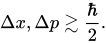


However, according to general relativity, concentrating too much energy into a small region of space will create a black hole if the energy corresponds to a Schwarzschild radius When the Schwarzschild radius becomes comparable to the uncertainty in position (), further localization becomes impossible, because the region collapses into a black hole.


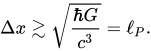
Combining these relations gives an approximate limit: Thus, the Planck length represents the smallest measurable distance in principle: below this scale, the very concept of "position" loses operational meaning. [20][21][22]
Conceptual implications
The existence of a minimum length scale is a common feature in approaches to quantum gravity, including string theory and loop quantum gravity. In these theories, spacetime may have a discrete or quantized structure at the Planck scale, preventing the definition of smaller distances.[23][24][25][26]
Summary
Meaning -Planck length, Electron, Compton wavelength, de Broglie wavelength- Quantum mechanics itself does not impose a fundamental smallest size, but when gravity is included, the Planck length is often regarded as the smallest physically meaningful scale.
- Size and Quantum Effects: Quantum mechanics becomes significant at scales on the order of nanometers (10⁻⁹ meters) or smaller, where properties like wave-particle duality, superposition, and quantization of energy levels dominate. For example, in atoms, electrons occupy discrete energy levels determined by the size of their orbitals.
- Scaling and Classical Transition: As size increases to macroscopic scales, quantum effects become negligible due to decoherence and the averaging of quantum probabilities. This is why classical mechanics describes larger systems effectively.
Specific Contexts
- Quantum Confinement: In nanostructures like quantum dots, the physical size of the system restricts electron movement, leading to quantized energy levels that depend directly on size.
- Heisenberg Uncertainty Principle: The smaller the spatial confinement (size), the larger the uncertainty in momentum, a purely quantum effect.
- Macroscopic Quantum Phenomena: In rare cases, like superconductors or Bose-Einstein condensates, quantum effects persist at larger scales, but these are exceptions and often involve low temperatures or specific conditions.
Theory
A quantum (plural quanta) is the smallest discrete unit of a physical property, such as energy, light, or angular momentum. For example, a photon is a quantum of light.
- Quantum physics is the branch of science that studies the behavior of matter and energy at very small scales, such as atoms and subatomic particles. It explores phenomena that classical physics cannot explain, including wave-particle duality and quantized energy levels.
- Quantum mechanics is the mathematical framework within quantum physics that provides the rules and equations to describe and predict the behavior of quantum systems. It includes principles such as the uncertainty principle, wavefunctions, and superposition.
So:
- Quantum = the smallest piece of a property.
- Quantum physics = the study of the behavior of these small pieces.
- Quantum mechanics = the set of rules and equations that describe how they behave.
Quantum Science consist of Quantum physics (QP) and Quantum mechanics (QM) describing the behaviour of matter and light at the atomic and subatomic scale.[27] These phenomena underlie technologies such as semiconductors, lasers, and solar cells, and form the basis of developing fields including quantum computing and quantum sensing.[28]
See also

⋅
- Quantum
- Noisy Qubits
- Physical Sciences
- Quantum: A Walk Through the Universe
- Measurement in quantum mechanics
- History of quantum mechanics
- Wave–particle duality
- Schrödinger equation
- Quantum entanglement
- Quantum computing
References
- ↑ Muller, M.; Katsov, K.; Schick, M. (November 2006). "Biological and synthetic membranes: What can be learned from a coarse-grained description?". Physics Reports 434 (5–6): 113–176. doi:10.1016/j.physrep.2006.08.003. ISSN 0370-1573.
- ↑ 2.0 2.1 2.2 2.3 "Sci-Tech Dictionary". McGraw-Hill Dictionary of Scientific and Technical Terms. (2003). McGraw-Hill Companies, Inc..
- ↑ 3.0 3.1 3.2 3.3 "Mesoscopic physics." McGraw-Hill Encyclopedia of Science and Technology. The McGraw-Hill Companies, Inc., 2005. Answers.com 25 Jan 2010. http://www.answers.com/topic/mesoscopic-physics-1
- ↑ Екимов А.И., Онущенко А.А. (1981). "Квантовый размерный эффект в трехмерных микрокристаллах полупроводников". Письма в ЖЭТФ 34: 363–366. Archived from the original on 16 December 2014. https://link.springer.com/article/10.1134/S0021364015230034. Retrieved 26 March 2015.
- ↑ "Russian-Born Quantum Dot Pioneer Ekimov Wins Nobel Prize in Chemistry". The Moscow Times. 2023-10-04. Retrieved 2023-10-06.
- ↑ "Alexei Ekimov | Biography, Nobel Prize, Quantum Dots, & Facts | Britannica". www.britannica.com. 2023-10-09. Retrieved 2023-10-11.
- ↑ Ekimov, A. I.; Onushchenko, A. A. (1981). "Quantum size effect in three-dimensional microscopic semiconductor crystals". JETP Letters 34 (6): 345–349. https://link.springer.com/article/10.1134/S0021364023130040.
- ↑ Sanderson, Katharine; Castelvecchi, Davide (4 October 2023). "Tiny 'quantum dot' particles win chemistry Nobel". Nature 622 (7982): 227–228. doi:10.1038/d41586-023-03048-9. PMID 37794149.
- ↑ Gramling, Carolyn (4 October 2023). "The development of quantum dots wins the 2023 Nobel prize in chemistry". Science News.
- ↑ Clery, Daniel; Kean, Sam (4 Oct 2023). "Creators of quantum dots, used in TV displays and cell studies, win chemistry Nobel". Science.
- ↑ Ekimov, A. I.; Onushchenko, A. A. (1981-09-01). "Quantum size effect in three-dimensional microscopic semiconductor crystals". Soviet Journal of Experimental and Theoretical Physics Letters 34: 345–349.
- ↑ Efros, Alexander L.; Brus, Louis E. (27 April 2021). "Nanocrystal Quantum Dots: From Discovery to Modern Development". ACS Nano 15 (4): 6192–6210. doi:10.1021/acsnano.1c01399. PMID 33830732.
- ↑ Ekimov, A. I.; Onushchenko, A. A.; Plyukhin, A. G.; Efros, Al. L. (1985-04-01). "Size quantization of excitons and determination of the parameters of their energy spectrum in CuCl". Physical Review B 31 (2): 1021–1026. https://www.researchgate.net/publication/285831802_Size_quantization_of_exciton_and_determination_of_their_energy_spectrum_parameters_in_CuCl.
- ↑ Griffiths, David J. (2005). Introduction to Quantum Mechanics (2nd ed.). Pearson Prentice Hall. ISBN 978-0131118928.
- ↑ Gamow, G. (1928). "Zur Quantentheorie des Atomkernes". Zeitschrift für Physik 51: 204–212. doi:10.1007/BF01343196.
- ↑ Fowler, R. H.; Nordheim, L. (1928). "Electron emission in intense electric fields". Proceedings of the Royal Society A 119: 173–181. doi:10.1098/rspa.1928.0091.
- ↑ Cohen-Tannoudji, Claude; Diu, Bernard; Laloë, Frank (1977). Quantum Mechanics. Wiley. ISBN 978-0471164333.
- ↑ Hänggi, P.; Talkner, P.; Borkovec, M. (1990). "Reaction-rate theory: fifty years after Kramers". Reviews of Modern Physics 62 (2): 251–341. doi:10.1103/RevModPhys.62.251.
- ↑ Binnig, G.; Rohrer, H. (1983). "Scanning tunneling microscopy". Surface Science 126: 236–244. https://journals.aps.org/prl/abstract/10.1103/PhysRevLett.49.57.
- ↑ Mead, C. A. (1964). "Possible Connection Between Gravitation and Fundamental Length". Physical Review 135 (3B): B849–B862. doi:10.1103/PhysRev.135.B849.
- ↑ Garay, L. J. (1995). "Quantum gravity and minimum length". International Journal of Modern Physics A 10 (2): 145–165. doi:10.1142/S0217751X95000159.
- ↑ Ng, Y. J.; van Dam, H. (1994). "Limit to space-time measurement". Modern Physics Letters A 9 (4): 335–340. https://www.worldscientific.com/doi/abs/10.1142/S0217732394000356.
- ↑ Rovelli, C. (2004). Quantum Gravity. Cambridge University Press. ISBN 978-0521837333.
- ↑ Thiemann, T. (2007). Modern Canonical Quantum General Relativity. Cambridge University Press. https://arxiv.org/abs/gr-qc/0110034.
- ↑ Polchinski, J. (1998). String Theory, Vols. 1 & 2. Cambridge University Press. https://www.cambridge.org/core/books/string-theory/30409AF2BDE27D53E275FDA395AB667A.
- ↑ Hossenfelder, S. (2013). "Minimal Length Scale Scenarios for Quantum Gravity". Living Reviews in Relativity 16: 2. doi:10.12942/lrr-2013-2.
- ↑ Griffiths, David J. (2018). Introduction to Quantum Mechanics (3rd ed.). Cambridge: Cambridge University Press. ISBN 978-1107189638.
- ↑ Dowling, Jonathan P.; Milburn, Gerard J. (2003). "Quantum technology: the second quantum revolution". Philosophical Transactions of the Royal Society A 361 (1809): 1655–1674. doi:10.1098/rsta.2003.1227. PMID 12952679. https://royalsocietypublishing.org/doi/10.1098/rsta.2003.1227.