Introduction
The topologization lemma for algebras allows the description of the stiffness of the Verknüpfungen in a topologischen Algebra over gauge functional. You can represent this learning resource as Wiki2Reveal slides.
Topologization Lemma for Algebras
Sei  an algebra. is precisely a topological algebra
  , which meets the Hausdorff property if the Topologie
  can be produced by a measuring functional system
  with the properties (A1)-(A5).
Characteristic properties (A1)-(A5)
- (A1)

- (A2)

- (A3)

- (A4)

- (A5)

Topology on Vector Spaces
Sei  a vector space. is precisely then a topological vector space
  , which meets the Hausdorff property if the topology can be produced by a measuring functional system having the properties (V1)-(V4).
Characteristic properties (V1)-(V4)
- (V1)

- (V2)

- (V3)

- (V4)

The topologischen Vektorraumes are missing the stetig inner probation of the multiplication  . Therefore, for topologischen Vektorraumes, only four characterizing properties (V1)-(V4) are obtained. The evidence of the properties is analogous to the proof of the topologization Lemma for topologische Algebren.
Hausdorff property
If the topological algebra does not meet the Hausdorff property, (A2) does not apply and two points  cannot be separated by the functional measuring system. Unless otherwise indicated, the topologische Algebren are house village f'sch.
Note 1: Proof structure
For proof, you have to show two directions,
- that for a topologischen Algebra a system of measuring functionals exists with the following properties (A1)-(A5) and
- Conversely, a system of measuring functionals with (A1)-(A5) produces a Topologie on , which makes a topologischen Algebra.
Note 2: Equivalent measuring functional system
Without limitation, we use a measuring functional system that is completely extended with respect to the radius of the  balls. This means that the measuring functional system is also extended by equivalent measuring functional of the form
  . This saves the use of constants in the following proof.
Stability in one point
The evidence suggests that in linear or bilinear Abbildung, the stiffness has to be detected only at one point (here zero vector) in order to demonstrate the stiffness in the whole definition range of the (bi-)linear Abbildung (see also Stetigkeitssatz für lineare Abbildungen))
Evidence
The following evidence establishes the following relationship with Topologie and Mengen for the properties (A1)-(A5).
- (A1)
 - Definition of the Minkowski function for absorbent Mengen
- (A2)
 Household Village Fact of the Topologie
- (A3)
 Stability of Multiplikation mit Skalaren
- (A4)
 Stability of the addition
- (A5)
 Strength of multiplication
Proof
Topological Vektorräumen own a neighborhood system of the zero vector  circular Mengen. It is then considered as a system of the Minkowski functional
  with
with  of this circular
Zero environments . Only two directions of evidence shall be shown:
of this circular
Zero environments . Only two directions of evidence shall be shown:
- A topologischen Algebra
 is given and the properties (A1)-(A5) are to be shown and vice versa
- for given Topologie-producing Gaugeunktional with the properties
 for , the algebra becomes a topologischen Algebra.
Proof (A1) Topologie given
A topologischen Algebra is given and the properties (A1) are shown.
Proof (A1.1) - Non-Negativity
With the circular zero environment 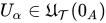 , the Minkowski function is defined:
 .
.
Proof (A1.2) - Non-Negativity
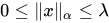
The property of non-negativity follows from the definition of Minkowski functionals, since an infimum is formed via positive numbers, with which an absorbent (circular) Menge still captures an element  ((698-1047-17615836065)). An infimum of positive numbers is at least not negative (i.e.
  .
.
Proof (A1) measuring functional system given
Conversely, if a Topologie-producing measuring functional system is given on an algebra that properties , then there is a neighborhood system of the zero vector made of circular Mengen.
Proof (A1.3) measuring functional system given
The neighborhood system of the zero vector  is defined with:

The Menge  is a zero environment because is the Topologie for .
Note (A1.4) measuring functional system given
It is possible to confine itself here to the 1-Umgebungen because the measurement functional system with respect to the wheel is completed without restriction, i.e. it may have been by equivalent measuring functionale of the form if applicable.
Proof (A1.5) measuring functional system given - zero environment circular
Furthermore, the Menge kreisförmig is applicable because with  ,
,  and
and  with (A3):

Thus,  also applies
  and
and  is kreisförmig.
Proof (A1.6) measuring functional system given - neighborhoods of vectors
For any vector  , the neighborhood base
  is defined as follows:

The Menge  is a neighborhood of
  , because is the Topologie for .
Proof (A1.7) measuring functional system given
is now the smallest Topologie produced by the Mengenystem  . In the further course it is now necessary to prove that the Multiplikation mit Skalaren, addition and multiplication are stetig on when the measuring system is functional.
Proof given (A2) Topologie
A topologischen Algebra is given and the property (A2) is to be shown.
Proof (A2.1) Hausdorff property given
The topological algebra according to definition Hausdorff space. It is considered with  . There is then a neighborhood
 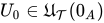 and
and  with
with  .
.
Proof (A2.2) Ha property given
Since in a topologischer Vektorraum (Algebra) a neighborhood system of the zero vector from circular Mengen
exists, there is a with
 . Since and
  apply,
  follows and thus the definition of Minkowski functionals
 and there is a with
Proof (A2) measuring functional system given
Conversely, if on an algebra a Topologie-producing measurement functional system is given that properties are fulfilled, then the House Village F property'' for the Topologie produced (698-1047-1761583604265-1241.
Proof (A2.3) Detection of house village f property
Sei  with be selected as desired. Now the Topologie-producing measuring functionals with are used to produce two neighborhoods
 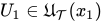 and
and 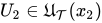 , for which Failed to parse (unknown function "\emptyMenge"): {\textstyle U_1 \cap U_2 = \emptyMenge }
applies.
, for which Failed to parse (unknown function "\emptyMenge"): {\textstyle U_1 \cap U_2 = \emptyMenge }
applies.
Proof (A2.4) Hausdorff property - double position
The Topologie of the algebra is now produced by a measurement functional system having the property (A1)-(A5). Condition (A2) is now applied to  :
:

The double posting of (A2) for  gives a with
  , since:

Proof (A2.5) Detection of Hausdorff property
We now apply the above double position to  . Therefore there is a with

With the condition (A4) there is a  with
with

Proof (A2.6) Hausdorff property - Definition of neighborhoods
Now use  to Menge the neighborhoods
 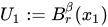 and
and 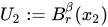 . Because of
  and
and  , in particular
  and
and  . In order to prove the house village f property, it is now possible to show Failed to parse (unknown function "\emptyMenge"): {\textstyle U_1 \cap U_2 = \emptyMenge }
.
. In order to prove the house village f property, it is now possible to show Failed to parse (unknown function "\emptyMenge"): {\textstyle U_1 \cap U_2 = \emptyMenge }
.
Proof (A2.7) Hausdorff property - acceptance - cut not empty
It is now assumed that the cut  is not the empty Menge and thus a
  exists, for which:

Objection, for 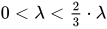 . So applies Failed to parse (unknown function "\emptyMenge"): {\textstyle U_1 \cap U_2 = \emptyMenge }
and the Topologie of the algebra is Household village.
. So applies Failed to parse (unknown function "\emptyMenge"): {\textstyle U_1 \cap U_2 = \emptyMenge }
and the Topologie of the algebra is Household village.
The condition (A2) therefore supplies the algebra Hausdorff property on the basis of the condition (A4). If the Hausdorff property is not required, the topologization of Lemma eliminates the property (A2).
Proof given (A3) Topologie
A topologischen Algebra is given and the properties (A3) are shown.
Proof (A3.1) Stability of Multiplikation mit Skalaren given
In a topological vectoraum (and of course also in a topologischen Algebra) there is a neighborhood system of the zero vector from circular Mengen. Considering the corresponding Minkowski functional, these are homogeneous in circular Mengen (i.e. measure functional). For any  , Failed to parse (unknown function "\Mengeminus"): {\textstyle \lambda \in \mathbb{K}\Mengeminus \{0\} }
and the circularity of :
, Failed to parse (unknown function "\Mengeminus"): {\textstyle \lambda \in \mathbb{K}\Mengeminus \{0\} }
and the circularity of :

This applies to 
Proof (A3.2) Stability of Multiplikation mit Skalaren given
It also applies to  ,
,  and
and 

All in all 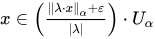 and about infimum formation are obtained. is obtained:
 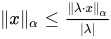 or
or  .
.
Proof (A3.3) Stability of Multiplikation mit Skalaren given
The reverse equation  is obtained with the circularity of and :
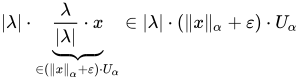
Thus, the infimum formation of is also obtained  .
.
Proof (A3.4) Stability of Multiplikation mit Skalaren given
Evidence step (A3.2) and (A3.3) together delivers equality  .
.
Proof (A3) measuring functional system given
Conversely, if a Topologie-producing measurement functional system is given on an algebra, that properties are fulfilled, then the stiffness of the Multiplikation mit Skalaren is shown with respect to .
Proof (A3.5) Stability of Multiplikation mit Skalaren show
Conversely, if there is a zero Folge  and a Netzes
  which is converged against the zero vector
  in the Topologie , the following applies:

This results in the use of condition (A3):

Proof (A3.6) Stetility of Multiplikation mit Skalaren show
In total  also converged against the zero vector , since for all
  a circular zero environment Failed to parse (unknown function "\subMengeeq"): {\textstyle U_\alpha \subMengeeq U }
exists. For this circular zero environment there is an index barrier
a circular zero environment Failed to parse (unknown function "\subMengeeq"): {\textstyle U_\alpha \subMengeeq U }
exists. For this circular zero environment there is an index barrier  , from which all Failed to parse (unknown function "\subMengeeq"): {\textstyle x_i \in U_\alpha \subMengeeq U }
are located with
, from which all Failed to parse (unknown function "\subMengeeq"): {\textstyle x_i \in U_\alpha \subMengeeq U }
are located with  . For a circular neighborhood system of the zero vector from
 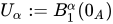 and
and  is also located in Failed to parse (unknown function "\subMenge"): {\textstyle \lambda_n \cdot x_i \in U_\alpha \subMenge U }
(i.e.
is also located in Failed to parse (unknown function "\subMenge"): {\textstyle \lambda_n \cdot x_i \in U_\alpha \subMenge U }
(i.e.  with
with  . The index barrier exists due to convergence of giving
  .
Overall, this shows the stiffness of the Multiplikation mit Skalaren on .
.
Overall, this shows the stiffness of the Multiplikation mit Skalaren on .
Proof (A4) Topologie given
A topologischen Algebra is given and the properties (A4) are shown.
Proof (A4.1) Stability of Addition
The stiffness of the addition provides:
- Failed to parse (unknown function "\subMenge"): {\displaystyle \forall_{\displaystyle U_{\alpha}\in \mathfrak{U} (0_A)} \exists_{\displaystyle U_\beta\in \mathfrak{U} (0_A)} : U_\beta + U_\beta \subMenge U_\alpha }
In particular, Failed to parse (unknown function "\subMenge"): {\textstyle U_\beta = U_\beta + \{0_A\} \subMenge U_\beta + U_\beta \subMenge U_\alpha }
applies because  applies. So...
Failed to parse (unknown function "\subMenge"): {\textstyle U_\beta \subMenge U_\alpha }
for the corresponding Minkowski functionals are also obtained
applies. So...
Failed to parse (unknown function "\subMenge"): {\textstyle U_\beta \subMenge U_\alpha }
for the corresponding Minkowski functionals are also obtained 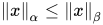 for all . This means that an absorbing subMenge
  must be inflated, if necessary, more strongly in comparison with in order to capture the corresponding .
Proof (A4.2) Stability of Addition
For  and
and  is
is  for all
  . In particular,
- Failed to parse (unknown function "\subMenge"): {\displaystyle x+y \in \lambda \cdot U_\beta +\lambda \cdot U_\beta = \lambda \cdot (U_\beta + U_\beta) \subMenge \lambda \cdot U_\alpha }
for all . This gives the searched (un-) equation directly with
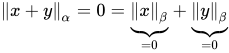 for all
  .
.
Proof (A4.3) Stability given by the addition
For  and ,
and ,  applies to all . It also applies to all because of infimum definition of the Minkowski function
  .
.
Proof (A4.4) Stability of the addition given
The desired inequality is obtained with for all
- Failed to parse (unknown function "\subMengeeq"): {\displaystyle \begin{array}{rcl} x+y & \in &(\varepsilon + \|x\|_\beta )\cdot U_\beta + (\underbrace{\varepsilon + \|x\|_\beta )}_{\lambda :=}\cdot U_\beta \\ & = & (\varepsilon + \|x\|_\beta )\cdot (U_\beta + U_\beta) \\ & \subMengeeq & (\varepsilon + \|x\|_\beta )\cdot U_\alpha \end{array} }
for all . So also applies 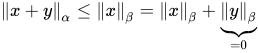 .
.
Proof (A4.5) Stability of Addition given
The statement is obtained analogously for or  .
.
Proof (A4.6) Stability of Addition
Seien now and . According to the definition of the Minkowski functionals for the zero environments and , for each :
- Failed to parse (unknown function "\subMenge"): {\displaystyle \begin{array}{rcl} \frac{x}{\left\| x \right\| _\beta+\varepsilon} \in U_\beta \, \wedge \, \frac{y}{\left\| y \right\| _\beta+\varepsilon} \in U_\beta &\Longrightarrow& \frac{x}{\left\| x \right\| _\beta+\left\| y \right\| _\beta}, \frac{y}{\left\| x \right\| _\beta+\left\| y \right\| _\beta} \in U_\beta \\ & \Longrightarrow & \frac{x+y}{\left\| x \right\| _\beta+\left\| y \right\| _\beta} \in U_\beta + U_\beta \subMenge U_\alpha \\ &\Longrightarrow& \left\| \frac{x+y}{\left\| x \right\| _\beta+\left\| y \right\| _\beta} \right\| _\alpha \leq 1 \Longrightarrow \mbox{ Beh. (A4). } \end{array} }
The circularity or Homogeneity (A3) of the Minkowski functionals used from the previous evidence.
Proof (A4) Gauge functional system
Conversely, if on an algebra a Topologie-producing measurement functional system is given that properties are fulfilled, then the stiffness of the addition is shown with respect to .
Proof (A4.7) Addition - Topologising by Measurement functionale
If the Topologie is generated by and the condition (A4), then applies:

Proof (A4.8) Addition - Topologising by Measurement Functional
Then the addition to is stetig, because for each zero environment from the circular neighborhood system of the zero vector is valid with  ,
,  and (698-1047-176236065-341

In total  and for any circular zero environment there is
 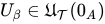 with Failed to parse (unknown function "\subMengeeq"): {\textstyle U_\beta + U_\beta \subMengeeq U_\alpha }
.
with Failed to parse (unknown function "\subMengeeq"): {\textstyle U_\beta + U_\beta \subMengeeq U_\alpha }
.
Proof given (A5) Topologie
A topologischen Algebra is given and the properties (A5) are shown.
Proof (A5.1) Multiplication - Topologie given
The rigidity of the multiplication is obtained as in 
- Failed to parse (unknown function "\subMenge"): {\displaystyle \forall_{\displaystyle U_{\alpha}\in \mathfrak{U} (0)} \exists_{\displaystyle U_\beta\in \mathfrak{U} (0)} : U_\beta \cdot U_\beta = U_\beta^{^2} \subMenge U_\alpha }
Proof (A5.2) Multiplication - Topologie given
Sei selected as desired and
the claim  , for:
- Failed to parse (unknown function "\subMenge"): {\displaystyle \frac{x}{\left\| x \right\| _\beta+\varepsilon}\cdot \frac{y}{\left\| y \right\| _\beta+\varepsilon} \in U_\beta \cdot U_\beta = U_\beta^2 \subMenge U_\alpha }
Proof (A5.3) Multiplication - Topologie given
From 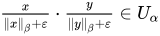 follows for all using property (A3) which applies with the above proof step for toplogical algebras also:

Since was chosen as desired, it is also valid
for all  .
.
Proof (A5) measuring functional system given
Conversely, if on an algebra a Topologie-producing measurement functional system is given that properties are fulfilled, then the stiffness of the multiplication is shown with respect to .
Proof (A5.4) Multiplication - Topologising by Measurement Functional
If the Topologie-producing measurement functional system meets the condition (A5), the following applies:

Proof (A5.5) Multiplication - Topologising by Measurement Functional
Conversely, with the same definition of and as open single balls and 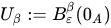 with open zero environments
  are obtained. We now show that all
  is the product
  . In particular,
  applies Failed to parse (unknown function "\subMenge"): {\textstyle U_\beta := B_\varepsilon^\beta (0_A) \subMenge B_1^\beta (0_A) =: U_\gamma }
and thus
applies Failed to parse (unknown function "\subMenge"): {\textstyle U_\beta := B_\varepsilon^\beta (0_A) \subMenge B_1^\beta (0_A) =: U_\gamma }
and thus  (see connection of Mengeninklusion and the
  relation over absorbent Mengen and (702-5761583).
Proof (A5.6) zero environment - circular zero environment
In the return direction of (A5), a circular zero environment  is obtained for each zero environment from the neighborhood system of circular Mengen with Failed to parse (unknown function "\subMenge"): {\textstyle U_\alpha \subMenge U }
, which was produced by a measuring functional as unit. This applies because the measuring functional system is Topologie-producing. Sei now
is obtained for each zero environment from the neighborhood system of circular Mengen with Failed to parse (unknown function "\subMenge"): {\textstyle U_\alpha \subMenge U }
, which was produced by a measuring functional as unit. This applies because the measuring functional system is Topologie-producing. Sei now

This gives  and thus .
Proof (A5.7) Multiplication - Topologising by Measurement Functional
The rigidity of the multiplication in a Topologie produced by the system is then obtained for any zero environment a circular zero environment Failed to parse (unknown function "\subMenge"): {\textstyle U_\alpha \subMenge U }
and with (A5) a with
- Failed to parse (unknown function "\subMengeeq"): {\displaystyle U_\beta \cdot U_\beta = U_\beta^2 \subMengeeq U_\alpha \subMengeeq U }
For the multiplication to stetig.
Proof steps (A1)-(A5)
Overall, it was shown that in topologische Algebren , the firmness of the Verknüpfungen produced on the algebra can also be demonstrated with the topologische Algebren measurement functional system or, for further statements on topologische Algebren, only with the measurement functional system. 
Basic Topologisierungslemma
Sei an algebra. is exactly a house village f'sche topologischen Algebra if the Topologie can be produced by a 'base-producing (698-1047-1761583604265-341-281)-Gaugefunktional system (698-1047)
- (B1)

- (B2)

- (B3)

- (B4)

- (B5)

Note: Basic measuring functional system
One basic measuring functional system has the same function as the use of -Umgebungen in the analysis. The -Umgebungen in  gave a base of standard Topologie on which can be expressed as convergence, stiffness and other topological properties. An analogous procedure as in measuring functionals was used.
![{\displaystyle x\in B_{\varepsilon }^{|\cdot |}(x_{0})\Longleftrightarrow |x-x_{0}|<\varepsilon \Longleftrightarrow x\in \,\,]x_{0}-\varepsilon ,x_{0}+\varepsilon [}](../_assets_/eb734a37dd21ce173a46342d1cc64c92/142666a593d7ec96da7a611207eec169c568190a.svg)
Proof task for students
Show the above properties (B1)-(B2) using the property of the measuring functional system to be basic. For each zero environment there is a with
- Failed to parse (unknown function "\subMengeeq"): {\displaystyle U \subMengeeq B_\varepsilon^{\alpha}(0_A) := \left\{ x \in A \, \colon \, \| x \|_\alpha < \varepsilon \right\} }
Tasks for students
Sei 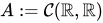 Menge the stetig functions of after with the following addition and multiplication on the Vektorraum:
- (Addition)
 are defined
  argument
  for all
- (multiplication) is defined
 argument
  for all
Furthermore, a measuring functional system  is defined with
  and
and  .
.
Task 1
Show that is a semi-standard system.
Task 2
- Specify a Failed to parse (unknown function "\Mengeminus"): {\textstyle f \in A\Mengeminus\{0_A\} }
for which
 applies to
  and
and  .
.
- Specify Failed to parse (unknown function "\Mengeminus"): {\textstyle g \in A\Mengeminus\{0_A\} }
, for which applies
 .
.
Task 3
Sei  Menge the constant functions in ,
  and
and  . Show that the following statement applies:
 .
.
Task 4
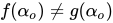
Show that the Hausdorff property (A2) applies in this topologischen Algebra. Note that applies with  and you can therefore find a
  in which
  applies. Designed with the measuring functionals two neighborhoods
  and
and  with Failed to parse (unknown function "\emptyMenge"): {\textstyle U_1 \cap U_2 = \emptyMenge }
.
with Failed to parse (unknown function "\emptyMenge"): {\textstyle U_1 \cap U_2 = \emptyMenge }
.
Task 5
Show that the Menge is a Ideal in topologischen Algebra .
See also
- Minkowski functionals
- measure functional
- Continuity sequence
- Ideal
- Topologische Algebra
- Topologische Gruppe
- Convergence in functional Raums