Introduction to thermodynamics/Extensive and intensive properties
From the macroscopic perspective, a system is viewed as a continuous, homogeneous matter called continuum, which consists of a huge number of interacting molecules distributed throughout the system. The interactions between the molecules are so frequent that the physical or bulk properties of the system do NOT depend on the behaviour of individual molecules. This hypothesis is valid in a wide range of engineering applications. It allows the physical properties of a system, such as pressure, density, and temperature, to be defined as a continuous function at any point of the system.
The following thermodynamic properties are typically used to describe the interactions between a system and its surroundings:
- mass
- pressure
- temperature
- volume and specific volume
- internal energy and specific internal energy
- enthalpy and specific enthalpy
- entropy and specific entropy


These properties can be classified into two categories based on their dependence on the mass of a system. More detailed explanations of their physical meanings can be found in later chapters.
- Extensive properties depend on the mass of a system. Properties, such as mass , volume , internal energy , enthalpy , and entropy are extensive properties. Their values change accordingly as the mass of a system changes.
- Intensive properties are independent of the mass of a system. Pressure , temperature , specific volume , specific internal energy , specific enthalpy , and specific entropy are intensive properties.
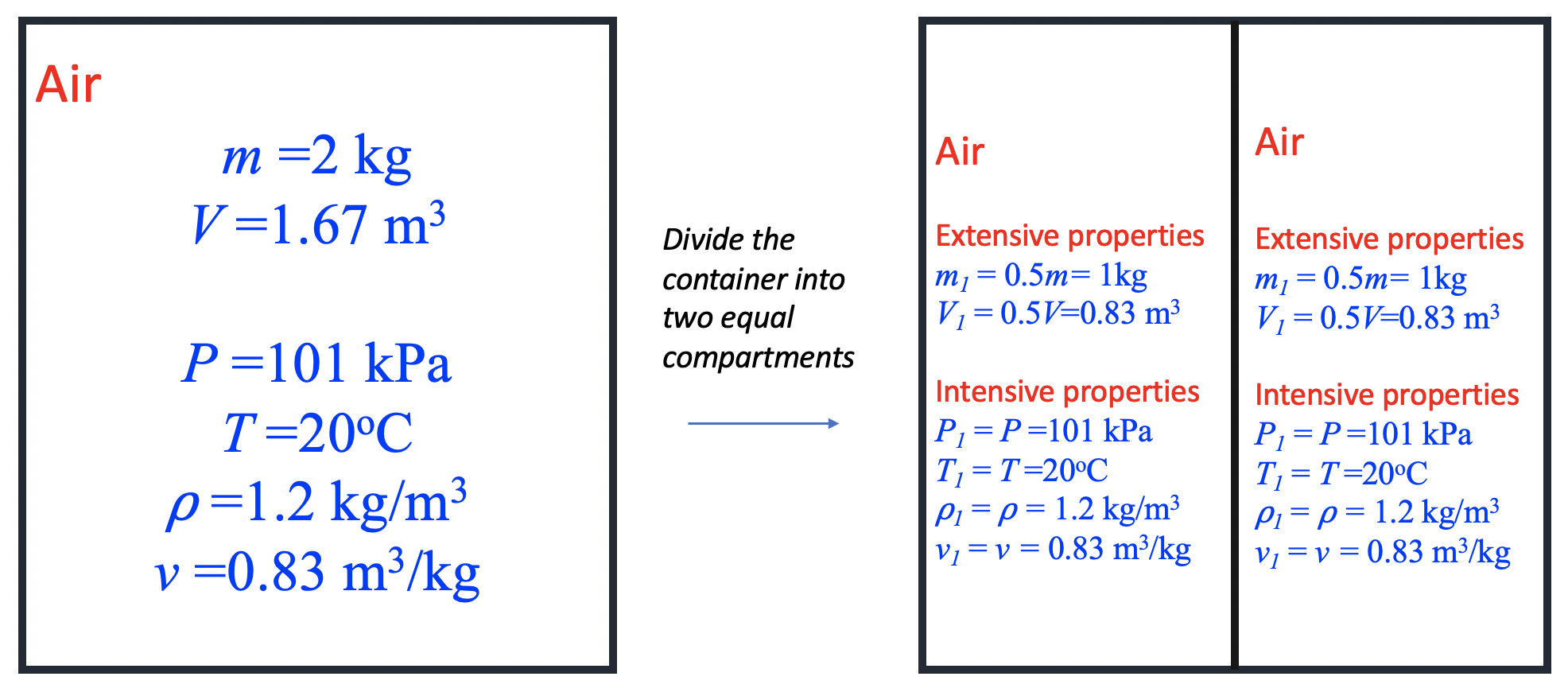
Let us consider a container of air at 101 kPa and 20oC. If the container is divided into two compartments and all other conditions remain unchanged, see Figure 1.3.1, the air in each compartment is still at 101 kPa and 20oC. The pressure and temperature of the air are not affected by the changing mass in each compartment; therefore, pressure and temperature are intensive properties. On the other hand, the mass and volume of the air in each of the compartments are different from the original values in the container. Both of them depend on the mass of the system; therefore, mass and volume are extensive properties.
All specific properties are intensive properties, as they refer to the corresponding extensive properties per unit mass, e.g., specific volume and specific internal energy .


Exercises
Practice problems 
|
Attribution
This chapter incorporates material from: "Extensive and intensive properties" in INTRODUCTION TO ENGINEERING THERMODYNAMICS by Claire Yu Yan, published by Pressbooks. Licensed under the Attribution-NonCommercial-ShareAlike 4.0 International.[2]
References
- ↑ "Intensive and extensive properties" by Claire Yu Yan is licensed under CC BY-NC-SA 4.0
- ↑ Pressboks. (2022). "Extensive and intensive properties" in INTRODUCTION TO ENGINEERING THERMODYNAMICS. Pressbooks. Licensed under CC BY-NC-SA 4.0.