In solid geometry, an ungula is a region of a solid of revolution, cut off by a plane oblique to its base.[1] A common instance is the spherical wedge. The term ungula refers to the hoof of a horse, an anatomical feature that defines a class of mammals called ungulates.
The volume of an ungula of a cylinder was calculated by Grégoire de Saint Vincent.[2] Two cylinders with equal radii and perpendicular axes intersect in four double ungulae.[3] The bicylinder formed by the intersection had been measured by Archimedes in The Method of Mechanical Theorems, but the manuscript was lost until 1906.
A historian of calculus described the role of the ungula in integral calculus:
- Grégoire himself was primarily concerned to illustrate by reference to the ungula that volumetric integration could be reduced, through the ductus in planum, to a consideration of geometric relations between the lies of plane figures. The ungula, however, proved a valuable source of inspiration for those who followed him, and who saw in it a means of representing and transforming integrals in many ingenious ways.[4]: 146
Cylindrical ungula
A cylindrical ungula of base radius r and height h has volume
 ,.[5]
,.[5]
Its total surface area is
 ,
,
the surface area of its curved sidewall is
 ,
,
and the surface area of its top (slanted roof) is
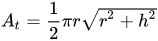 .
.
Proof
Consider a cylinder  bounded below by plane
  and above by plane
  where k is the slope of the slanted roof:
 .
.
Cutting up the volume into slices parallel to the y-axis, then a differential slice, shaped like a triangular prism, has volume

where

is the area of a right triangle whose vertices are,  ,
, 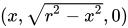 , and
, and  ,
and whose base and height are thereby
,
and whose base and height are thereby  and
and  , respectively.
Then the volume of the whole cylindrical ungula is
, respectively.
Then the volume of the whole cylindrical ungula is

![{\displaystyle \qquad ={1 \over 2}k{\Big (}[r^{2}x]_{-r}^{r}-{\Big [}{1 \over 3}x^{3}{\Big ]}_{-r}^{r}{\Big )}={1 \over 2}k(2r^{3}-{2 \over 3}r^{3})={2 \over 3}kr^{3}}](./1f0c2358c4da5fdb21c02aa34d2b20b096b1a0c6.svg)
which equals
after substituting  .
.
A differential surface area of the curved side wall is
 ,
,
which area belongs to a nearly flat rectangle bounded by vertices  ,
,  ,
,  , and
, and  , and whose width and height are thereby
  and (close enough to)
  , respectively.
Then the surface area of the wall is
, respectively.
Then the surface area of the wall is

where the integral yields ![{\displaystyle -[\cos \theta ]_{0}^{\pi }=-[-1-1]=2}](./15158580a2008fc222feaac419d82ec128c0b10c.svg) , so that the area of the wall is
, so that the area of the wall is
 ,
,
and substituting yields
- .
The base of the cylindrical ungula has the surface area of half a circle of radius r:  , and the slanted top of the said ungula is a half-ellipse with semi-minor axis of length r and semi-major axis of length
  , so that its area is

and substituting  yields
- . ∎
Note how the surface area of the side wall is related to the volume: such surface area being  , multiplying it by
  gives the volume of a differential half-shell, whose integral is
  , the volume.
When the slope k equals 1 then such ungula is precisely one eighth of a bicylinder, whose volume is  . One eighth of this is
  .
.
Conical ungula
A conical ungula of height h, base radius r, and upper flat surface slope k (if the semicircular base is at the bottom, on the plane z = 0) has volume

where
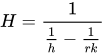
is the height of the cone from which the ungula has been cut out, and
 .
.
The surface area of the curved sidewall is
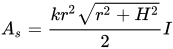 .
.
As a consistency check, consider what happens when the height of the cone goes to infinity, so that the cone becomes a cylinder in the limit:

so that
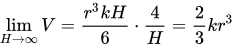 ,
,
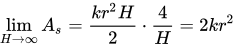 , and
, and
 ,
,
which results agree with the cylindrical case.
Proof
Let a cone be described by

where r and H are constants and z and ρ are variables, with

and
 .
.
Let the cone be cut by a plane
 .
.
Substituting this z into the cone's equation, and solving for ρ yields
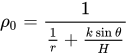
which for a given value of θ is the radial coordinate of the point common to both the plane and the cone that is farthest from the cone's axis along an angle θ from the x-axis. The cylindrical height coordinate of this point is
 .
.
So along the direction of angle θ, a cross-section of the conical ungula looks like the triangle
 .
.
Rotating this triangle by an angle  about the z-axis yields another triangle with
  ,
,  ,
,  substituted for
  ,
,  , and
, and  respectively, where and are functions of instead of . Since is infinitesimal then and also vary infinitesimally from and , so for purposes of considering the volume of the differential trapezoidal pyramid, they may be considered equal.
The differential trapezoidal pyramid has a trapezoidal base with a length at the base (of the cone) of  , a length at the top of
 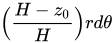 , and altitude
 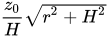 , so the trapezoid has area
 .
.
An altitude from the trapezoidal base to the point  has length differentially close to
 .
.
(This is an altitude of one of the side triangles of the trapezoidal pyramid.) The volume of the pyramid is one-third its base area times its altitudinal length, so the volume of the conical ungula is the integral of that:

where

Substituting the right hand side into the integral and doing some algebraic manipulation yields the formula for volume to be proven.
For the sidewall:

and the integral on the rightmost-hand-side simplifies to  . ∎
. ∎
As a consistency check, consider what happens when k goes to infinity; then the conical ungula should become a semi-cone.
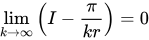

which is half of the volume of a cone.

which is half of the surface area of the curved wall of a cone.
Surface area of top part
When  , the "top part" (i.e., the flat face that is not semicircular like the base) has a parabolic shape and its surface area is
 .
.
When  then the top part has an elliptic shape (i.e., it is less than one-half of an ellipse) and its surface area is

where
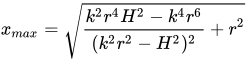 ,
,
 ,
,
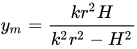 ,
,
 , and
, and
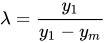 .
.
When  then the top part is a section of a hyperbola and its surface area is

where
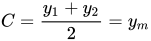 ,
,
 is as above,
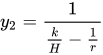 ,
,
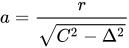 ,
,
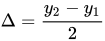 ,
,
 ,
,
where the logarithm is natural, and
 .
.
See also
References
External links