Seventeen Provinces
Seventeen Provinces | |||||||||||
|---|---|---|---|---|---|---|---|---|---|---|---|
| 1549–1581 | |||||||||||
Map of the Netherlands in 1555, with the Seventeen Provinces highlighted in color. States which may be geographically considered part of the Netherlands, but which were not part of the Habsburg Netherlands shown in light grey. | |||||||||||
| Status | Personal union of Imperial fiefs | ||||||||||
| Capital | Brussels | ||||||||||
| Common languages | |||||||||||
| Religion |
| ||||||||||
| Government | Monarchy | ||||||||||
| Historical era | Early modern period | ||||||||||
| 1549 | |||||||||||
• Dutch Act of Abjuration | 1581 | ||||||||||
| ISO 3166 code | NL | ||||||||||
| |||||||||||
The Seventeen Provinces (Dutch: Zeventien Provinciën, French: Dix-Sept Provinces, Spanish: Diecisiete Provincias) was a term used to describe the Spanish Netherlands before the Dutch Revolt, when they were at their largest extent. They covered most of the Low Countries, i.e., what is now the Netherlands, Belgium, Luxembourg, and most of the French departments of Nord (French Flanders and French Hainaut) and Pas-de-Calais (Artois).
The Seventeen Provinces arose from the Burgundian Netherlands, a number of fiefs held by the House of Valois-Burgundy and inherited by the House of Habsburg in 1482, and held by Habsburg Spain from 1556. Starting in 1512, the Provinces formed the major part of the Burgundian Circle. In 1581, many of these provinces seceded to form what would eventually become the Dutch Republic.
Definition and composition
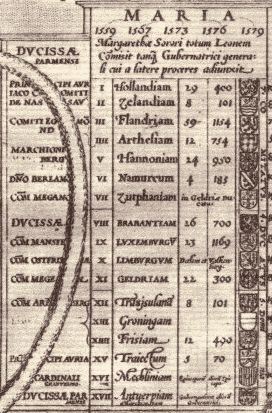
Despite what the name might suggest, there is no agreed upon definition of which provinces constituted the Seventeen Provinces, as the term "province" was one of convenience, and thus different authors choose to make sense of the intricate patchwork of fiefdoms across Early Modern Europe in different ways. For instance: some lists count "Guelders and Zutphen" either together or separately; Antwerp was often historically considered one of the seventeen provinces, but nowadays many modern historians prefer to regard it simply as a part of Brabant, and include either Walloon Flanders or the Territory of Drenthe. In fact, whether there are even seventeen provinces is debatable, it's thought that the number may have been chosen due to its Christian connotation.[1]
Always included
The eight the provinces which declared independence Act of Abjuration, which laid the groundwork for what would eventually become the Republic of the Seven United Netherlands, are always included:
- Duchy of Brabant
- Duchy of Guelders and the County of Zutphen (sometimes counted separately)
- County of Flanders
- County of Holland
- County of Zeeland (linked to the County of Holland)
- Lordship of Frisia
- Lordship of Malines (fully reconquered by the Spanish in 1585)[2]
- Lordship of Utrecht
The following seven provinces did not sign the Act of Abjuration (though the two lordships of Groningen and Overyssel were implicitly declared independent by it due to having been part of the Union of Utrecht and later became full provinces of the Republic):
- Duchy of Limburg (sometimes listed as "Limburg and Overmaas", despite the Overmaas already being considered part of the Duchy of Brabant)
- Duchy of Luxembourg
- County of Artois
- County of Hainaut
- County of Namur
- Lordship of Groningen (the Ommelanden was one of the original signatories of the Union of Utrecht, but the city of Groningen itself remained loyal to the Spanish until 1594)[3]
- Lordship of Overyssel (the States of Overyssel had joined the Union of Utrecht under Orangist pressure, but remained heavily contested right up until the Peace of Münster)[4]
Debatably included
- Margraviate of Antwerp (listed as one of the provinces in the Treaty of Venlo,[5][6][7][8] but nowadays often considered simply a part of Brabant)
- Walloon Flanders (umbrella term for the burgraviates of Lille (including its castellany), Douai, Orchies, as well as the lordship of the Tournaisis, all of which exerted some level of de facto independence from the County of Flanders)
- Territory of Drenthe (eighth province of the Seven United Netherlands; otherwise included as part of Overyssel)
Always excluded
States which were geographically part of the Low Countries, but which were not Habsburg possessions, were not considered part of the Seventeen Provinces under any definition. This excludes ecclesiastical states such as Prince-Bishopric of Liège (including the County of Horne), Camerick and Stavelot-Malmedy, as well as the then culturally Dutch Duchy of Clèves and Juliers.
The Burgundy and surrounding lands were never included as part of the Seventeen Provinces, despite being a Habsburg possession since 1493. Lands which were considered private property of certain nobles rather than full-fledged countries, included but not limited to Ravenstein and Ameland, were also not considered part of the Seventeen Provinces.
History
The Seventeen Provinces originated from the Burgundian Netherlands. The dukes of Burgundy systematically became the lords of different provinces. Mary I of Valois, Duchess of Burgundy was the last of the House of Burgundy.
Mary married Archduke Maximilian in 1477, and the provinces were acquired by the House of Habsburg on her death in 1482, with the exception of the Duchy of Burgundy itself, which, with an appeal to Salic law, had been reabsorbed into France upon the death of Mary's father, Charles the Bold. Maximilian and Mary's grandson, Charles V, Holy Roman Emperor and king of Spain, eventually united all 17 provinces under his rule, the last one being the Duchy of Guelders, in 1543.
Most of these provinces were fiefs of the Holy Roman Empire. Two provinces, the County of Flanders and the County of Artois, were originally French fiefs, but sovereignty was ceded to the Empire in the Treaty of Cambrai in 1529.
On 15 October, 1506, in the palace of Mechelen, the future Charles V was recognized as Heer der Nederlanden ("Lord of the Netherlands"). Only he and his son ever used this title. The Pragmatic Sanction of 1549 determined that the Provinces should remain united in the future and inherited by the same monarch.
After Charles V's abdication in 1555, his realms were divided between his son, Philip II of Spain, and his brother, Ferdinand I, Holy Roman Emperor. The Seventeen Provinces went to his son, the king of Spain.
Conflicts between Philip II and his Dutch subjects led to the Eighty Years' War, which started in 1568. The seven northern provinces gained their independence as a republic called the Seven United Provinces. They were:
- the Lordship of Groningen and of the Ommelanden
- the Lordship of Friesland
- the Lordship of Overijssel
- the Duchy of Guelders (except its upper quarter) and the County of Zutphen
- the Prince-Bishopric, later Lordship of Utrecht
- the County of Holland
- the County of Zeeland
The southern provinces, Flanders, Brabant, Namur, Hainaut, Luxembourg and the others, were restored to Spanish rule due to the military and political talent of the Duke of Parma, especially at the Siege of Antwerp (1584–1585). Hence, these provinces became known as the Spanish Netherlands.
The County of Drenthe, surrounded by the other northern provinces, became de facto part of the Seven United Provinces, but had no voting rights in the Union of Utrecht and was therefore not considered a province.
The northern Seven United Provinces kept parts of Limburg, Brabant, and Flanders during the Eighty Years' War (see Generality Lands), which ended with the Treaty of Westphalia in 1648.
Artois and parts of Flanders and Hainaut (French Flanders and French Hainaut) were ceded to France in the course of the 17th and 18th centuries.
Economy
By the mid-16th century, the Margraviate of Antwerp (Duchy of Brabant) had become the economic, political, and cultural centre of the Netherlands after its capital had shifted from the nearby Lordship of Mechelen to the city of Brussels.
Bruges (County of Flanders) had already lost its prominent position as the economic powerhouse of northern Europe, while Holland was gradually gaining importance in the 15th and 16th centuries.
However, after the revolt of the seven northern provinces (1568), the Sack of Antwerp (1576), the Fall of Antwerp (1584–1585), and the resulting closure of the Scheldt river to navigation, a large number of people from the southern provinces emigrated north to the new republic. The centre of prosperity moved from cities in the south such as Bruges, Antwerp, Ghent, and Brussels to cities in the north, mostly in Holland, including Amsterdam, The Hague, and Rotterdam.
Netherlands
To distinguish between the older and larger Low Countries of the Netherlands from the current country of the Netherlands, Dutch speakers usually drop the plural for the latter. They speak of Nederland in the singular for the current country and of de Nederlanden in the plural for the integral domains of Charles V.
In other languages, this has not been adopted, though the larger area is sometimes known as the Low Countries in English.
The fact that the term Netherlands has such different historical meanings can sometimes lead to difficulties in expressing oneself correctly. For example, composers from the 16th century are often said to belong to the Dutch School (Nederlandse School). Although they themselves would not have objected to that term at that time, nowadays it may wrongly create the impression that they were from the current Netherlands. In fact, they were almost exclusively from current Belgium.
Flanders
The same confusion exists around the word Flanders. Historically, it applied to the County of Flanders, corresponding roughly with the present-day provinces of West Flanders, East Flanders and French Flanders. However, when the Dutch-speaking population of Belgium sought more rights in the 19th century, the word Flanders was reused, this time to refer to the Dutch-speaking part of Belgium, which is larger and contains only part of the old county of Flanders (see Flemish Movement). Therefore, the territory of the County of Flanders and that of present-day Flanders do not fully match:
- French Flanders belonged to the County of Flanders, but is today part of France.
- Zeelandic Flanders belonged to the County of Flanders, but is today part of the Netherlands.
- Tournai and the Tournaisis was some period considered as part of the County of Flanders, but is today part of Wallonia.
- The present-day Belgian province of Flemish Brabant belongs to present-day Flanders, but was part of the Duchy of Brabant.
- The present-day Belgian province of Antwerp belongs to present-day Flanders, but was part of the Duchy of Brabant.
- The present-day Belgian province of Limburg belongs to present-day Flanders, but was part of the Prince-Bishopric of Liège.
This explains, for instance, why the province of East Flanders is not situated in the east of present-day Flanders.
See also
- Governors of the Habsburg Netherlands
- The Netherlands (disambiguation)
- Burgundian Netherlands
- Pan-Netherlands
- French Flemish
- Benelux
References
- ^ "The invention of the Dutchman". Leiden University. 20 March 2007. Archived from the original on 17 May 2011. Retrieved 9 August 2020.
- ^ Modesto Lafuente (1862). Historia general de España, Volume 7. p. 401. Retrieved 12 July 2023.
- ^ "De munt van Groningen". De Kopergeld pagina. 19 October 2004. Archived from the original on 10 March 2008.
- ^ "De munt van Overijssel". De Kopergeld pagina. 27 October 2004. Archived from the original on 7 April 2008.
- ^ Arnold Hermann Ludwig Heeren (1834). A Manual of the History of the Political System of Europe and Its Colonies. p. 65.
- ^ "De namen van de Zeventien Provinciën (image)". Engelfriet. Archived from the original on 5 April 2022. Retrieved 12 July 2023.
- ^ "Ruzie met de Raad van State leidde tot de 80-jarige oorlog". 13 January 2005. Archived from the original on 29 May 2023. Retrieved 12 July 2023.
- ^ "Wapens van de Zeventien Provinciën, Abraham de Bruyn (mogelijk), naar Chrispijn van den Broeck, 1582". Rijksmuseum. Archived from the original on 12 July 2023. Retrieved 12 July 2023.