In mathematics, Jacobi polynomials (occasionally called hypergeometric polynomials)  are a class of classical orthogonal polynomials. They are orthogonal with respect to the weight
 on the interval
 ![{\displaystyle [-1,1]}](./51e3b7f14a6f70e614728c583409a0b9a8b9de01.svg) . The Gegenbauer polynomials, and thus also the Legendre, Zernike and Chebyshev polynomials, are special cases of the Jacobi polynomials.[1]
. The Gegenbauer polynomials, and thus also the Legendre, Zernike and Chebyshev polynomials, are special cases of the Jacobi polynomials.[1]
The Jacobi polynomials were introduced by Carl Gustav Jacob Jacobi.
Definitions
Via the hypergeometric function
The Jacobi polynomials are defined via the hypergeometric function as follows:[2][1]: IV.1

where  is Pochhammer's symbol (for the rising factorial). In this case, the series for the hypergeometric function is finite, therefore one obtains the following equivalent expression:

An equivalent definition is given by Rodrigues' formula:[1]: IV.3 [3]

If  , then it reduces to the Legendre polynomials:

Differential equation
The Jacobi polynomials  is, up to scaling, the unique polynomial solution of the Sturm–Liouville problem[1]: IV.2

where  . The other solution involves the logarithm function. Bochner's theorem states that the Jacobi polynomials are uniquely characterized as polynomial solutions to Sturm–Liouville problems with polynomial coefficients.
Alternate expression for real argument
For real  the Jacobi polynomial can alternatively be written as

and for integer 

where  is the gamma function.
In the special case that the four quantities ,  ,
,  ,
,  are nonnegative integers, the Jacobi polynomial can be written as
 | | 1 |
The sum extends over all integer values of  for which the arguments of the factorials are nonnegative.
Special cases



Thus, the leading coefficient is 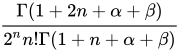 .
.
Basic properties
Orthogonality
The Jacobi polynomials satisfy the orthogonality condition

As defined, they do not have unit norm with respect to the weight. This can be corrected by dividing by the square root of the right hand side of the equation above, when  .
.
Although it does not yield an orthonormal basis, an alternative normalization is sometimes preferred due to its simplicity:

Symmetry relation
The polynomials have the symmetry relation

thus the other terminal value is

Derivatives
The  th derivative of the explicit expression leads to

Recurrence relations
The 3-term recurrence relation for the Jacobi polynomials of fixed  ,
,  is:[1]: IV.5

for  .
Writing for brevity
.
Writing for brevity  ,
,  and
and  , this becomes in terms of

Since the Jacobi polynomials can be described in terms of the hypergeometric function, recurrences of the hypergeometric function give equivalent recurrences of the Jacobi polynomials. In particular, Gauss' contiguous relations correspond to the identities[4]: Appx.B

Generating function
The generating function of the Jacobi polynomials is given by

where

and the branch of square root is chosen so that  .[1]: IV.4
Other polynomials
The Jacobi polynomials reduce to other classical polynomials.[5]
Ultraspherical:Legendre:Chebyshev:Laguerre:Hermite:
Stochastic process
The Jacobi polynomials appear as the eigenfunctions of the Markov process on ![{\displaystyle [-1,+1]}](./daa72f1a806823ec94fda7922597b19cbda684f4.svg) defined up to the time it hits the boundary. For
defined up to the time it hits the boundary. For  , we haveThus this process is named the Jacobi process.[6][7]
Heat kernel
Let
![{\displaystyle J^{(\alpha ,\beta )}:=-\left(1-x^{2}\right){\frac {d^{2}}{dx^{2}}}-[\beta -\alpha -(\alpha +\beta +2)x]{\frac {d}{dx}}}](./5c6764ea1ee6dab0d1aff5a7a1294fc4ad338262.svg)

![{\displaystyle h_{n}^{(\alpha ,\beta )}=\int _{-1}^{1}\left[P_{n}^{(\alpha ,\beta )}(x)\right]^{2}(1-x)^{\alpha }(1+x)^{\beta }dx={\frac {2^{\alpha +\beta +1}\Gamma (n+\alpha +1)\Gamma (n+\beta +1)}{(2n+\alpha +\beta +1)\Gamma (n+\alpha +\beta +1)\Gamma (n+1)}}}](./77ef9cf6d99a32a90662949db49af302ce7ac378.svg)
![{\displaystyle G_{t}^{(\alpha ,\beta )}(x,y)=\sum _{n=0}^{\infty }\exp(-tn(n+\alpha +\beta +1)){\frac {P_{n}^{(\alpha ,\beta )}(x)P_{n}^{(\alpha ,\beta )}(y)}{h_{n}^{(\alpha ,\beta )}}},\quad x,y\in [-1,1],\quad t>0,}](./d03df99aea07d5527e121b32e0fe044149a6e056.svg)

Then, for any  ,[8]Thus,
  is called the Jacobi heat kernel.
Other properties
The discriminant is[9]Bailey’s formula:[8][10]where  , and
, and  is Appel's hypergeometric function of two variables. This is an analog of the Mehler kernel for Hermite polynomials, and the Hardy–Hille formula for Laguerre polynomials.
Laplace-type integral representation:[11]
Zeroes
If  , then has real roots. Thus in this section we assume by default. This section is based on.[12][13]
Define:
 are the positive zero of the Bessel function of the first kind
  , ordered such that
  .
. are the zeroes of
 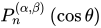 , ordered such that
  .
.

Inequalities
 is strictly monotonically increasing with and strictly monotonically decreasing with .[12]
If  , and
, and  , then is strictly monotonically increasing with .[12]
When ![{\displaystyle \alpha ,\beta \in [-1/2,+1/2]}](./9a4ed30088cb74f9090fa8762de46494ca56a07c.svg) ,[12]
,[12]

 for
for 
 except when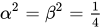
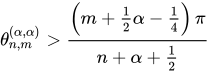 for , except when
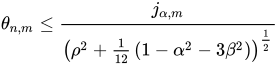
 for
for
Asymptotics
Fix  . Fix
. Fix  .
.
uniformly for  .
.
Electrostatics
The zeroes satisfy the Stieltjes relations:[14][15]
The first relation can be interpreted physically. Fix an electric particle at +1 with charge  , and another particle at -1 with charge
  . Then, place electric particles with charge
  . The first relation states that the zeroes of are the equilibrium positions of the particles. This equilibrium is stable and unique.[15]
Other relations, such as  , are known in closed form.[14]
As the zeroes specify the polynomial up to scaling, this provides an alternative way to uniquely characterize the Jacobi polynomials.
The electrostatic interpretation allows many relations to be intuitively seen. For example:
- the symmetry relation between and
 ;
;
- the roots monotonically decrease when increases;
Since the Stieltjes relation also exists for the Hermite polynomials and the Laguerre polynomials, by taking an appropriate limit of  , the limit relations are derived. For example, for the Hermite polynomials, the zeros satisfyThus, by taking
  limit, all the electric particles are forced into an infinitesimal neighborhood of the origin, where the field strength is linear. Then after scaling up the line, we obtain the same electrostatic configuration for the zeroes of Hermite polynomials.
Asymptotics
For in the interior of , the asymptotics of for large is given by the Darboux formula[1]: VIII.2

where

and the " " term is uniform on the interval
 ![{\displaystyle [\varepsilon ,\pi -\varepsilon ]}](./a2aec0a4485c35292703c489dbe3b0374cac6edc.svg) for every
for every  .
.
For higher orders, define:[12]
 is the Euler beta function
 is the falling factorial.


Fix real , fix  , fix
, fix  . As
. As  ,uniformly for all
 ![{\displaystyle \theta \in [\delta ,\pi -\delta ]}](./79e12bd1a10fbd0ba32d5666b762ef8305cdea90.svg) .
.
The  case is the above Darboux formula.
Define:[12]
 is the Bessel function

Fix real , fix  . As , we have the Hilb's type formula:[16]where
  are functions of
  . The first few entries are:
For any fixed arbitrary constant  , the error term satisfies
The asymptotics of the Jacobi polynomials near the points  is given by the Mehler–Heine formula
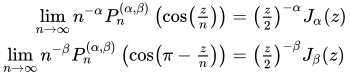
where the limits are uniform for  in a bounded domain.
The asymptotics outside is less explicit.
Applications
Wigner d-matrix
The expression (1) allows the expression of the Wigner d-matrix
 (for
(for  )
in terms of Jacobi polynomials:[17]
)
in terms of Jacobi polynomials:[17]
![{\displaystyle d_{m'm}^{j}(\phi )=(-1)^{\frac {m-m'-|m-m'|}{2}}\left[{\frac {(j+M)!(j-M)!}{(j+N)!(j-N)!}}\right]^{\frac {1}{2}}\left(\sin {\tfrac {\phi }{2}}\right)^{|m-m'|}\left(\cos {\tfrac {\phi }{2}}\right)^{|m+m'|}P_{j-M}^{(|m-m'|,|m+m'|)}(\cos \phi ),}](./36f2d8c1ddb9f4d3b89c5da33b0dffb05e70cfa5.svg)
where  .
.
See also
References
- ^ a b c d e f g (Szegő 1975, 4. Jacobi polynomials)
- ^ Abramowitz, Milton; Stegun, Irene Ann, eds. (1983) [June 1964]. "Chapter 22". Handbook of Mathematical Functions with Formulas, Graphs, and Mathematical Tables. Applied Mathematics Series. Vol. 55 (Ninth reprint with additional corrections of tenth original printing with corrections (December 1972); first ed.). Washington D.C.; New York: United States Department of Commerce, National Bureau of Standards; Dover Publications. p. 561. ISBN 978-0-486-61272-0. LCCN 64-60036. MR 0167642. LCCN 65-12253.
- ^ P.K. Suetin (2001) [1994], "Jacobi polynomials", Encyclopedia of Mathematics, EMS Press
- ^ Creasey, P. E. "A Unitary BRDF for Surfaces with Gaussian Deviations".
- ^ "DLMF: §18.7 Interrelations and Limit Relations ‣ Classical Orthogonal Polynomials ‣ Chapter 18 Orthogonal Polynomials". dlmf.nist.gov.
- ^ Wong, E. (1964). "The construction of a class of stationary Markoff processes" (PDF). In Bellman, R. (ed.). Stochastic Processes in Mathematical Physics and Engineering. Providence, RI: American Mathematical Society. pp. 264–276.
- ^ Demni, N.; Zani, M. (2009-02-01). "Large deviations for statistics of the Jacobi process". Stochastic Processes and their Applications. 119 (2): 518–533. doi:10.1016/j.spa.2008.02.015. ISSN 0304-4149.
- ^ a b Nowak, Adam; Sjögren, Peter (2011-11-14), Sharp estimates of the Jacobi heat kernel, arXiv, doi:10.48550/arXiv.1111.3145, arXiv:1111.3145
- ^ "DLMF: §18.16 Zeros ‣ Classical Orthogonal Polynomials ‣ Chapter 18 Orthogonal Polynomials". dlmf.nist.gov.
- ^ Bailey, W. N. (1938). "The Generating Function of Jacobi Polynomials". Journal of the London Mathematical Society. s1-13 (1): 8–12. doi:10.1112/jlms/s1-13.1.8. ISSN 1469-7750.
- ^ Dijksma, A.; Koornwinder, T. H. (1971-01-01). "Spherical harmonics and the product of two Jacobi polynomials". Indagationes Mathematicae (Proceedings). 74: 191–196. doi:10.1016/S1385-7258(71)80026-4. ISSN 1385-7258.
- ^ a b c d e f "DLMF: §18.15 Asymptotic Approximations ‣ Classical Orthogonal Polynomials ‣ Chapter 18 Orthogonal Polynomials". dlmf.nist.gov.
- ^ (Szegő 1975, Section 6.21. Inequalities for the zeros of the classical polynomials)
- ^ a b Marcellán, F.; Martínez-Finkelshtein, A.; Martínez-González, P. (2007-10-15). "Electrostatic models for zeros of polynomials: Old, new, and some open problems". Journal of Computational and Applied Mathematics. Proceedings of The Conference in Honour of Dr. Nico Temme on the Occasion of his 65th birthday. 207 (2): 258–272. doi:10.1016/j.cam.2006.10.020. ISSN 0377-0427.
- ^ a b (Szegő 1975, Section 6.7. Electrostatic interpretation of the zeros of the classical polynomials)
- ^ (Szegő 1975, 8.21. Asymptotic formulas for Legendre and Jacobi polynomials)
- ^ Biedenharn, L.C.; Louck, J.D. (1981). Angular Momentum in Quantum Physics. Reading: Addison-Wesley.
- Szegő, Gábor (1975) [1939]. Orthogonal Polynomials. Colloquium Publications. Vol. 23 (4th ed.). American Mathematical Society. ISBN 978-0-8218-1023-1.
Further reading
- Andrews, George E.; Askey, Richard; Roy, Ranjan (1999), Special functions, Encyclopedia of Mathematics and its Applications, vol. 71, Cambridge University Press, ISBN 978-0-521-62321-6, MR 1688958, ISBN 978-0-521-78988-2
- Koornwinder, Tom H.; Wong, Roderick S. C.; Koekoek, Roelof; Swarttouw, René F. (2010), "Orthogonal Polynomials", in Olver, Frank W. J.; Lozier, Daniel M.; Boisvert, Ronald F.; Clark, Charles W. (eds.), NIST Handbook of Mathematical Functions, Cambridge University Press, ISBN 978-0-521-19225-5, MR 2723248.
External links
Authority control databases |
|---|
| International | |
|---|
| National | |
|---|
| Other | |
|---|