In mathematics, a half range Fourier series is a Fourier series defined on an interval ![{\displaystyle [0,L]}](./53e3bfad6c2b8297e8c8d2e84ce8f869d69b0d86.svg) instead of the more common
instead of the more common ![{\displaystyle [-L,L]}](./3821e4ce807a6a5d059c66d3c8802a17a8d6e92c.svg) , with the implication that the analyzed function
, with the implication that the analyzed function ![{\displaystyle f(x),x\in [0,L]}](./ec9d8fdc2cdaf4aa5b51121bdf23c189ede06e11.svg) should be extended to
should be extended to ![{\displaystyle [-L,0]}](./5833a1327584eff57fb6531c29b9a8110648dab7.svg) as either an even (
as either an even ( ) or odd function (
 ).[1] This allows the expansion of the function in a series solely of sines (odd) or cosines (even). The choice between odd and even is typically motivated by boundary conditions associated with a differential equation satisfied by
  .[2]
.[2]
Definition and motivation
Given a function defined over the interval , the half-range Fourier series extends  to with either an even or an odd extension. An even extension satisfies the identity
![{\displaystyle f(-x)=f(x)\quad {\text{for}}\quad x\in [0,L]}](./e3a7fdff56beea7e1bfb722a9275c07807f7306c.svg)
And an odd extension satisfies the identity
![{\displaystyle f(-x)=-f(x)\quad {\text{for}}\quad x\in [0,L]}](./562cdaa7611a684860199d96bf7735e0d98092ab.svg)
An even extension relies on the cosine function since the cosine function is even, and an odd extension uses the sine function since the sine function is odd. The decision between even and odd extensions is usually motivated by the boundary conditions of the problem, especially with partial differential equations such as heat and wave equations.[2]
Let be defined and piecewise continuous on the interval . The half range Fourier series for sine and cosine are given as follows:[3]

And the coefficients  are given by
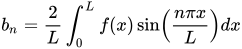
The cosine series is given as

And the coefficients  are given by

Applications
Half range Fourier series are used in solving certain boundary value problems involving heat conduction, vibration, and other physical phenomena modeled by partial differential equations.[4] The advantage in a half range Fourier series is that the function analyzed need only be defined over , meaning functions only defined over positive numbers can be analyzed with a half range Fourier series. Another advantage is using only sines or only cosines. For example, if  , it can be more practical to use a sine series rather than a full Fourier series. If
  , it can be more practical to use a cosine series instead.[5]
Example 1.
The half range Fourier sine series expansion for 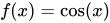 with
with  is computed as follows. Because we want a sine series, it will take the form:

With coefficients given by:

Noting that because  , these terms cancel out giving only
  . We substitute the definition of and obtain

Using the product to sum identity given by  , we convert the integrand into
![{\displaystyle {\begin{aligned}b_{n}={\frac {2}{\pi }}\int _{0}^{\pi }{\frac {\sin((n+1)x)+\sin((n-1)x)}{2}}\,dx=\\{\frac {2}{\pi }}\cdot {\frac {1}{2}}\int _{0}^{\pi }{\Big [}\sin((n+1)x)+\sin((n-1)x){\Big ]}\end{aligned}}}](./7a9f69f03a4c7a5ff4fec7dcc2bc86b859cf6cc8.svg)
Applying the fact that for  ,
,  , and that
  , we have

Applying to both terms of the integrand we have
![{\displaystyle b_{n}={\frac {1}{\pi }}\left[{\frac {1-(-1)^{n+1}}{n+1}}+{\frac {1-(-1)^{n-1}}{n-1}}\right],\quad n\neq 1}](./5e147c729092caadcf7489998ff61a19d0187209.svg)
If  is odd, then both
  and
and  are even, meaning
  , and thus the denominators are equal to
  . Thus, we have

We apply this to the special case of  as well. Then, if is even, then
  , and thus and are odd, meaning
  . Thus, both denominators become
  , and we obtain
![{\displaystyle b_{2k}={\frac {1}{\pi }}\left[{\frac {2}{2k+1}}+{\frac {2}{2k-1}}\right]={\frac {2}{\pi }}\left[{\frac {1}{2k+1}}+{\frac {1}{2k-1}}\right]}](./7682bef9bddade322c9eb1de0b45fa14686f94b2.svg)
Combining into a single fraction, we have

Therefore:
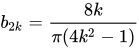
Because  when is odd, we can substitute
  directly to get the full summation:

References
- ^ Rudin, Walter (2008). Principles of mathematical analysis. International series in pure and applied mathematics (3. ed., [Nachdr.] ed.). New York: McGraw-Hill. ISBN 978-0-07-054235-8.
- ^ a b Strauss, Walter A. (1992). Partial differential equations: an introduction. New York: Wiley. ISBN 978-0-471-54868-3.
- ^ Körner, T. W.; Tao, Terence (2022). Fourier analysis. Cambridge mathematical library (Reprinted with foreword ed.). Cambridge, United Kingdom New York, NY, USA Port Melbourne, VIC, Australia New Delhi, India Singapore: Cambridge University Press. ISBN 978-1-009-23005-6.
- ^ Zauderer, Erich (2006). Partial differential equations of applied mathematics. Pure and applied mathematics (3rd ed.). Hoboken, N.J: Wiley-Interscience. ISBN 978-0-471-69073-3.
- ^ Arfken, George B.; Weber, Hans-Jurgen; Harris, Frank E. (2013). Mathematical methods for physicists: a comprehensive guide (7th ed.). Amsterdam ; Boston: Elsevier. ISBN 978-0-12-384654-9.