In mathematics,  ,[1] sometimes called the golden field,[2] is a number system consisting of the set of all numbers
  , where
  and
and  are both rational numbers and
  is the square root of 5, along with the basic arithmetical operations (addition, subtraction, multiplication, and division). Because its arithmetic behaves, in certain ways, the same as the arithmetic of
  , the field of rational numbers, is a field. More specifically, it is a real quadratic field, the extension field of generated by combining rational numbers and using arithmetical operations. The name comes from the golden ratio
  , a positive number satisfying the equation
  , which is the fundamental unit of .
Calculations in the golden field can be used to study the Fibonacci numbers and other topics related to the golden ratio, notably the geometry of the regular pentagon and higher-dimensional shapes with fivefold symmetry.
Basic arithmetic
Elements of the golden field are those numbers which can be written in the form where and are uniquely determined rational numbers, or in the form  where , , and
  are integers, which can be uniquely reduced to lowest terms, and where
  is the square root of 5.[4] It is sometimes more convenient instead to use the form
  where and are rational or the form
  where , , and are integers, and where
 is the golden ratio.[5]
Converting between these alternative forms is straight-forward:  or, in the other direction,
  .
.
To add or subtract two numbers, simply add or subtract the components separately:
To multiply two numbers, distribute:
To find the reciprocal of a number  , rationalize the denominator:

 , where
  is the algebraic conjugate and
  is the field norm, as defined below. Explicitly:
To divide two numbers, multiply the first by second's reciprocal:
As in any field, addition and multiplication of numbers in is associative and commutative;  is the additive identity and
  is the multiplicative identity; every number has an additive inverse
  and a multiplicative inverse
  ; and multiplication distributes over addition. Arithmetic between numbers in is consistent with their arithmetic as real numbers; that is, is a subfield of
  .
.
Conjugation and norm
The numbers and  each solve the equation
  . Each number
 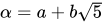 in has an algebraic conjugate found by swapping these two square roots of 5, i.e., by changing the sign of . The conjugate of is

 . A rational number is its own conjugate. In general, the conjugate is:
Conjugation in is an involution,
. A rational number is its own conjugate. In general, the conjugate is:
Conjugation in is an involution,  , and it preserves the structure of arithmetic:
  ;
;  ; and
; and 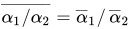 . Conjugation is the only ring homomorphism (function preserving the structure of addition and multiplication) from to itself, other than the identity function.[12]
The field trace is the sum of a number and its conjugates (so-called because multiplication by an element in the field can be seen as a kind of linear transformation, the trace of whose matrix is the field trace). The trace of in is 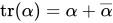 :
This is always an (ordinary) rational number.
:
This is always an (ordinary) rational number.
The field norm is a measure of a number's magnitude, the product of the number and its conjugates. The norm of in is  :
This is also always a rational number.
:
This is also always a rational number.
The norm preserves the structure of multiplication, as expected for a concept of magnitude. The norm of a product is the product of norms,  ; and the norm of a quotient is the quotient of the norms,
  . A number and its conjugate have the same norm,
 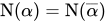 ;
;
A number in and its conjugate are the solutions of the quadratic equation
In Galois theory, the golden field can be considered more abstractly as the set of all numbers  , where and are both rational, and all that is known of
  is that it satisfies the equation
  . There are two ways to embed this set in the real numbers: by mapping to the positive square root or alternatively by mapping to the negative square root . Conjugation exchanges these two embeddings. The Galois group of the golden field is thus the group with two elements, namely the identity and an element which is its own inverse.
Golden integers
The ring of integers of the golden field, ![{\displaystyle \mathbb {Z} [\varphi ]}](./14f984c2710477c64fca0f16a71928134bdb8201.svg) , sometimes called the golden integers,[15] is the subset of algebraic integers in the field, meaning those elements whose minimal polynomial over has integer coefficients. These are the set of numbers in whose norm is an integer. The numbers and form an integral basis for the ring, meaning every number in the ring can be written in the form where and are ordinary integers. Alternately, elements of can be written in the form
, sometimes called the golden integers,[15] is the subset of algebraic integers in the field, meaning those elements whose minimal polynomial over has integer coefficients. These are the set of numbers in whose norm is an integer. The numbers and form an integral basis for the ring, meaning every number in the ring can be written in the form where and are ordinary integers. Alternately, elements of can be written in the form  , where and have the same parity. Like any ring, is closed under addition and multiplication.
The set of all norms of golden integers includes every number 
 for ordinary integers and . These are precisely the integers whose prime factors which are congruent to
  modulo
  occur with even exponents. The first several non-negative integer norms are:[18]
- , ,
 , ,
, ,  ,
,  ,
,  ,
,  ,
,  ,
,  ,
,  , . . . .
The golden integer  is called zero, and is the only element of with norm .
A unit is an algebraic integer whose multiplicative inverse is also an algebraic integer, which happens when its norm is  . Thus the units are all numbers of the form whose integer coefficients and solve the Diophantine equation
  . If the unit is instead written in the form , the coefficients solve a related Diophantine equation, the generalized Pell's equation
  . The fundamental unit – the smallest unit greater than – is the golden ratio
 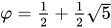 and the other units consist of its positive and negative powers,
  , for any integer
  . Some powers of are:

|

|

|

|
|
|

|

|
|
|
|

|
|

|

|
|
|

|

|

|
|

|
In general  , where
  is the th Fibonacci number.[20] The units form a group under multiplication, which can be decomposed as the direct product
  of a cyclic group of order 2 and an infinite cyclic group, respectively generated by and .
Two golden integers are associates if their quotient in  is a unit; that is, two golden integers
  and
and  are associates if
  for some integer . Associateness is an equivalence relation. Associates have the same norm, up to sign:
  . However, not all elements whose norm has the same absolute value are associates; in particular, any golden prime and its conjugate have the same norm, but are associates if and only if they are associated either with or with an ordinary prime.
The prime elements of the ring, analogous to prime numbers among the integers, are of three types: 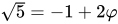 , integer primes of the form
  where is an integer, and the factors of integer primes of the form
  (a pair of conjugates). For example, , , and
  are primes, but
  is composite. Any of these is an associate of additional primes found by multiplying it by a unit; for example
  is also prime because is a unit.
The ring is a Euclidean domain with the absolute value of the norm as its Euclidean function, meaning a version of the Euclidean algorithm can be used to find the greatest common divisor of two numbers. This makes one of the 21 quadratic fields that are norm-Euclidean.[24]
Like all Euclidean domains, the ring shares many properties with the ring of integers. In particular, it is a principal ideal domain, and it satisfies a form of the fundamental theorem of arithmetic: every element of can be written as a product of prime elements multiplied by a unit, and this factorization is unique up to the order of the factors and the replacement of any prime factor by an associate prime (which changes the unit factor accordingly).
In the table below, positive golden integers have been arranged into rows, with one representative chosen for each class of associates (here the representative is the positive element in the class for which  is a minimum).
Matrix representation
is a two-dimensional vector space over , and multiplication by any element of is a linear transformation of that vector space. Given an ordered basis of , each number in can be associated to the corresponding transformation matrix in that basis. This defines a field isomorphism (a structure-preserving bijective map) from to the space of  square matrices with rational entries spanned by the identity matrix
  , the image of the number , and a matrix
  , the image of .[25] Thus arithmetic of numbers in can be alternately represented by the arithmetic of such matrices.[26] In this context, the number
  is represented by the matrix
  . A convenient choice of basis for is
  , in terms of which is a symmetric matrix:[28]
The adjugate matrix  represents the algebraic conjugate
  , the matrix
  (satisfying
  ) represents ,[29] and the adjugate of an arbitrary element
  , which we will denote
  , represents the number
  :
:
Every matrix , except for the zero matrix, is invertible, and its inverse  represents the multiplicative inverse
 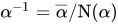 in .
in .
If is an element of , with conjugate , then the matrix has the numbers and as its eigenvalues. Its trace is 

 .[31] Its determinant is
  . The characteristic polynomial of is
  , which is the minimal polynomial of and whenever is not zero. These properties are shared by the adjugate matrix
  . Their product is
 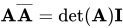 .[26][25]
These matrices have especially been studied in the context of the Fibonacci numbers and Lucas numbers  , which appear as the entries of
  and
and  , respectively:
Powers of are sometimes called Fibonacci matrices.[32]
, respectively:
Powers of are sometimes called Fibonacci matrices.[32]
Every matrix of the form  has eigenvectors which point along the directions
  and
and  .[33] When numbers in are plotted, as above, in a coordinate system where their values as real numbers are the horizontal axis and the values of their conjugates are the vertical axis, the eigenvectors point along those two axes. (Zero is the only number directly on either axis.) The matrices
  for integer , representing units, and more generally any matrices with
  and determinant , are squeeze mappings, which stretch the plane along one axis and squish it along the other, fixing hyperbolas of constant norm. The matrices
  and more generally matrices with and determinant , are the composition of a squeeze mapping and a vertical reflection. The negative identity matrix
  is a point reflection across the origin. In general any other matrix can be decomposed as the product of a squeeze mapping, possibly a reflection, and a uniform scaling by the square root of the absolute value of its determinant.
Other properties
The golden field is the real quadratic field with the smallest discriminant,  . It has class number 1 and is a unique factorization domain.[35]
Any positive element of the golden field can be written as a generalized type of continued fraction, in which the partial quotients are sums of non-negative powers of .
Fibonacci numbers
is a natural choice of number system for studying the Fibonacci numbers and the Lucas numbers . These number sequences are usually defined by recurrence relations similar to the one satisfied by the powers of and  :
:
The sequences and respectively begin:[38]
|
|

|

|

|

|

|

|

|

|

|

|

|
|

|
|

|
|
|
|
|
|
|

|

|

|

|

|

|

|
|

|
|
|
|
|
|
|

|
|

|

|

|

|

|
|
Both sequences can be consistently extended to negative integer indices by following the same recurrence in the negative direction. They satisfy the identities[39]
The Fibonacci and Lucas numbers can alternately be expressed as the components and when a power of the golden ratio or its conjugate is written in the form :[40]
The expression of the Fibonacci numbers in terms of is called Binet's formula:[41]
The powers of or , when written in the form , can be expressed in terms of just Fibonacci numbers,
Powers of or times can be expressed in terms of just Lucas numbers,
Statements about golden integers can be recast as statements about the Fibonacci or Lucas numbers; for example, that every power of is a unit of ,  , when expanded, becomes Cassini's identity, and likewise
  becomes the analogous identity about Lucas numbers,
The numbers  and
and  are the roots of the quadratic polynomial
  . This is the minimal polynomial for for any non-zero integer .[43] The quadratic polynomial
  is the minimal polynomial for
  .[44]
.[44]
In the limit, consecutive Fibonacci or Lucas numbers approach a ratio of , and the ratio of Lucas to Fibonacci numbers approaches :[4]
Theorems about the Fibonacci numbers – for example, divisibility properties such as if divides  then divides
  – can be conveniently proven using .[45]
Relation to fivefold symmetry
The golden ratio  is the ratio between the lengths of a diagonal and a side of a regular pentagon, so the golden field and golden integers feature prominently in the metrical geometry of the regular pentagon and its symmetry system, as well as higher-dimensional objects and symmetries involving five-fold symmetry.
Euclidean plane
Let 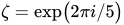 be the 5th root of unity, a complex number of unit absolute value spaced
  of a full turn from around the unit circle, satisfying
  . Then the fifth cyclotomic field
  is the field extension of the rational numbers formed by adjoining
  (or equivalently, adjoining any of
  ,
,  or
or  ). Elements of are numbers of the form

 , with rational coefficients. is of degree four over the rational numbers: any four of the five roots are linearly independent over , but all five sum to zero. However, is only of degree two over ,
where the conjugate . The elements of can alternately be represented as
, with rational coefficients. is of degree four over the rational numbers: any four of the five roots are linearly independent over , but all five sum to zero. However, is only of degree two over ,
where the conjugate . The elements of can alternately be represented as  , where and
  are elements of :
Conversely, is a subfield of . For any primitive root of unity  , the maximal real subfield of the cyclotomic field
  is the field
  ; see Minimal polynomial of
  . In our case
  ,
, 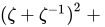
 , so
, so  is the positive root of the quadratic polynomial
  , namely
  , and the maximal real subfield of is .[46]
The squared absolute value of any element of is an element of :
In particular, the squared length of the side of a regular pentagon of unit circumradius is 

 and the squared length of its diagonal is

 ; these two numbers are conjugates, associates of . In a regular decagon with unit circumradius, the squared length of a side is
  and the squared length of a diagonal between vertices three apart is
  .
.
Golden integers are involved in the trigonometric study of fivefold symmetries. By the quadratic formula,
Angles of  and
and  thus have golden rational cosines but their sines are the square roots of golden rational numbers.[47]
Three-dimensional space
A regular icosahedron with edge length can be oriented so that the Cartesian coordinates of its vertices are
Four-dimensional space
The 600-cell is a regular 4-polytope with 120 vertices, 720 edges, 1200 triangular faces, and 600 tetrahedral cells. It has kaleidoscopic symmetry ![{\displaystyle [5,3,3]}](./d5a43aec7a9e2758707d07cddc99e36f91a9d13f.svg) generated by four mirrors which can be conveniently oriented as
generated by four mirrors which can be conveniently oriented as  ,
,  ,
,  , and
, and  . Then the 120 vertices have golden-integer coordinates: arbitrary permutations of
  and
and  with an even number of minus signs,
  with an odd number of minus signs, and
 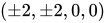 .[49]
.[49]
Higher dimensions
The icosians are a special set of quaternions that are used in a construction of the E8 lattice. Each component of an icosian always belongs to the golden field. The icosians of unit norm are the vertices of a 600-cell.
Quasiperiodicity
Golden integers are used in studying quasicrystals.
Other applications
The quintic case of Fermat's Last Theorem, that there are no nontrivial integer solutions to the equation  , was proved using by Gustav Lejeune Dirichlet and Adrien-Marie Legendre in 1825–1830.[53]
In enumerative geometry, it is proven that every non-singular cubic surface contains exactly 27 lines. The Clebsch surface is unusual in that all 27 lines can be defined over the real numbers. They can, in fact, be defined over the golden field.
In quantum information theory, an abelian extension of the golden field is used in a construction of a SIC-POVM in four-dimensional complex vector space.
Notes
- ^ The expression
 is pronounced "the rational numbers adjoin the square root of five", or, more concisely, "Q adjoin root five". See Trifković 2013, p. 6.
- ^ The name golden field was apparently introduced in 1988 by John Conway and Neil Sloane in the 1st edition of their book Sphere Packings, Lattices and Groups (§ 8.2.1, p. 207). See Conway & Sloane 1999 for the 3rd edition. The name is relatively uncommon; most sources use symbolic names such as or .
- ^ a b Sloane, "Decimal expansion of square root of ", OEIS A002163.
- ^ Sloane, "Decimal expansion of golden ratio (or
 )
)  ", OEIS A001622.
- ^ This is true for conjugation in quadratic fields in general. See Trifković 2013, p. 62.
- ^ For instance by Rokhsar, Mermin & Wright 1987; Lehrer & Taylor 2009, p. 253.
- ^ Sloane, "Positive numbers of the form
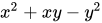 ", OEIS A031363.
- ^ Wasteels 1902; Dodd 1983, p. 22; Dimitrov, Cosklev & Bonevsky 1995.
- ^ A list of primes can be found in Dodd 1983, Appendix B, "A List of Primes", pp. 128–150.
- ^ LeVeque 1956, pp. 56–57; Sloane, "Squarefree values of for which the quadratic field
![{\displaystyle \mathbf {Q} [{\sqrt {n}}~\!]}](./102d8fc8d9fd2f2fb8ca4d3ad7a38856f97455c8.svg) is norm-Euclidean", OEIS A048981.
is norm-Euclidean", OEIS A048981.
- ^ a b Liba & Ilany 2023, p. 15; Fontaine & Hurley 2011 also mention the isomorphism between the real subfield of the cyclotomic field and the arithmetic of matrices spanned by and , which they call the silver matrices
![{\displaystyle S[5,1]}](./eade34606e86acdfe69c64e2480527f95423075a.svg) and
and ![{\displaystyle S[5,2]}](./37d28870ad388737204edcc2a7b83baa9df3a050.svg) . Méndez-Delgadillo, Lam-Estrada & Maldonado-Ramírez 2015 work with the basis
. Méndez-Delgadillo, Lam-Estrada & Maldonado-Ramírez 2015 work with the basis  , relative to which the matrix
  represents :
  In this basis, the golden ratio is represented by a matrix
 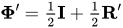 :
:  This is the same idea as using the matrices
  and : arithmetic of these matrices is likewise isomorphic to arithmetic in
  , and the eigenvalues, characteristic polynomial, trace, and determinant are the same in any basis. However, the eigenvectors are
  and
and  rather than and .
- ^ a b Rotman 2017, p. 456 ff. describes this for finite-dimensional field extensions in general.
- ^ Our matrix , or the mirrored variant
![{\displaystyle {\bigl [}{\begin{smallmatrix}1&1\\1&0\end{smallmatrix}}{\bigr ]}}](./d6bd41b1df6016696ca8fd637422f98feb58aaf2.svg) , is commonly denoted
, is commonly denoted  or
or  in work about the Fibonacci numbers. See Gould 1981 for a survey in that context. Here we use the symbol for consistency with the symbol and to avoid confusion with the rational numbers , which are also often denoted . Liba & Ilany 2023, p. 15 also use the symbol , and call this the "golden matrix".
- ^ Hoggatt & Ruggles 1963; Liba & Ilany 2023, p. 16
- ^ Here
 means the matrix trace of and means the field trace of in .
- ^ Bicknell & Hoggatt 1973, pp. 18–26; Gould 1981.
- ^ Here the symbol
 indicates the transpose of a matrix, so is a column vector.
- ^ Sloane, "
 is a unique factorization domain", OEIS A003172
- ^ Vajda 1989, p. 31 plots these points and hyperbolas rotated and scaled so that
 and
and  coordinates make a square grid aligned with the page.
- ^ Sloane, "Fibonacci numbers", OEIS A000045; Sloane, "Lucas numbers beginning at ", OEIS A000032.
- ^ Vajda 1989, p. 10; Sloane, "[...] Fibonacci numbers extended to negative indices", OEIS A039834.
- ^ Lind 1968; Vajda 1989, p. 52
- ^ Dodd 1983, p. 5. The formula was developed by Abraham de Moivre (1718) and then independently by Jacques Philippe Marie Binet (1843) and Gabriel Lamé (1844); see Vajda 1989, p. 52.
- ^ For
 , which is its own conjugate, the polynomial
 is not minimal.
- ^ Because, as described in § Conjugation and norm,

 for any in . In this case,
  ,
,  ,
,  , and
, and  .
.
- ^ Dodd 1983, § 9.4 "Divisibility Properties of the Fibonacci Numbers", pp. 119–126 proves this and various related results. See also Carlitz 1964.
- ^ Shurman 1997, p. 77. More generally, for any odd prime
 , the field
 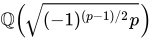 is a subfield of
  . Moreover, by the Kronecker–Weber theorem, every abelian extension of the rationals is contained in some cyclotomic field. See Ireland & Rosen 1990, pp. 199–200.
- ^ Bradie 2002; Huntley 1970, pp. 39–41.
- ^ Coxeter 1985; Denney et al. 2020.
- ^ Ribenboim 1999; Dirichlet 1828; Legendre 1830; Dodd 1983, § 9.3 "The Equation
 ", pp. 110–118.
References
- Appleby, Marcus; Bengtsson, Ingemar; Grassl, Markus; Harrison, Michael; McConnell, Gary (2022). "SIC-POVMs from Stark units: Prime dimensions
 ". Journal of Mathematical Physics. 63: 112205. arXiv:2112.05552. doi:10.1063/5.0083520.
- Baez, John (1 Mar 2016). "Clebsch Surface". Visual Insight (Blog). American Mathematical Society. Retrieved 2025-06-22.
- Bengtsson, Ingemar (2017). "The number behind the simplest SIC-POVM". Foundations of Physics. 47: 1031–1041. arXiv:1611.09087. doi:10.1007/s10701-017-0078-3.
- Bernat, Julien (2006). "Continued fractions and numeration in the Fibonacci base". Discrete Mathematics. 306 (22): 2828–2850. doi:10.1016/j.disc.2006.05.020.
- Bicknell, Marjorie; Hoggatt, Verner E. Jr. (1973). A Primer for the Fibonacci Numbers. Fibonacci Association.
- Boukas, Andreas; Feinsilver, Philip; Fellouris, Anargyros (2016). "Probability distributions and orthogonal polynomials associated with the one-parameter Fibonacci group". Communications on Stochastic Analysis. 10 (1): 117–130. doi:10.31390/cosa.10.1.08.
- Bradie, Brian (2002). "Exact Values for the Sine and Cosine of Multiples of
 – A Geometric Approach". Classroom Capsules. The College Mathematics Journal. 33 (4): 318–319. doi:10.1080/07468342.2002.11921960.
- Carlitz, L. (1964). "A Note on Fibonacci Numbers" (PDF). The Fibonacci Quarterly. 2 (1): 15–28. doi:10.1080/00150517.1964.12431525.
- Conway, John H.; Sloane, Neil J. A. (1999). "Algebraic Constructions for Lattices". Sphere Packings, Lattices and Groups (3rd ed.). New York: Springer. pp. 206–244. doi:10.1007/978-1-4757-6568-7_8. ISBN 0-387-98585-9.
- Coxeter, H. S. M. (1985). "Regular and semi-regular polytopes. II". Mathematische Zeitschrift. 188 (4): 559–591. doi:10.1007/bf01161657.
- Dembélé, Lassina (2005). "Explicit computations of Hilbert modular forms on " (PDF). Experimental Mathematics. 14 (4): 457–466. doi:10.1080/10586458.2005.10128939. Zbl 1152.11328.
- Denney, Tomme; Hooker, Da'Shay; Johnson, De'Janeke; Robinson, Tianna; Butler, Majid; Claiborne, Sandernisha (2020). "The geometry of H4 polytopes". Advances in Geometry. 20 (3): 433–444. arXiv:1912.06156. doi:10.1515/advgeom-2020-0005.
- Dickson, Leonard E. (1923). Algebras and their Arithmetics. University of Chicago Press.
- Dimitrov, Vassil S.; Cosklev, T. V.; Bonevsky, B. (1995). "Number theoretic transforms over the golden section quadratic field". IEEE Transactions on Signal Processing. 43 (8): 1790–1797. doi:10.1109/78.403338.
- Dirichlet, Gustav Lejeune (1828). "Mémoire sur l'impossibilité de quelques équations indéterminées du cinquième degré". Journal für die reine und angewandte Mathematik. 3: 354–375. doi:10.1515/crll.1828.3.354.
- Dodd, Fred W. (1983). Number theory in the quadratic field with golden section unit. Passaic, NJ: Polygonal Publishing House. ISBN 0-936428-08-2.
- Fontaine, Anne; Hurley, Susan (2011). "Golden Matrix Families". The College Mathematics Journal. 42 (2): 140–147. doi:10.4169/college.math.j.42.2.140.
- Gould, Henry W. (1981). "A History of the Fibonacci Q-Matrix and a Higher-Dimensional Problem" (PDF). The Fibonacci Quarterly. 19 (3): 250–257. doi:10.1080/00150517.1981.12430088.
- Hardy, G. H.; Wright, E. M. (1954). "Quadratic Fields (2)". An Introduction to the Theory of Numbers (3rd ed.). Oxford: Clarendon Press. Ch. XV, pp. 218–232.
- Hirzebruch, Friedrich (1976). "The Hilbert modular group for the field
 , and the cubic diagonal surface of Clebsch and Klein". Russian Mathematical Surveys. 31 (5): 96–110. doi:10.1070/RM1976v031n05ABEH004190. MR 0498397.
- Hoggatt, Verner E. Jr.; Ruggles, Ivan D. (1963). "A Primer for the Fibonacci Numbers – Part IV" (PDF). The Fibonacci Quarterly. 1 (4): 65–71. doi:10.1080/00150517.1963.12431555.
- Hunt, Bruce (1996). "The 27 lines on a cubic surface". The Geometry of some special Arithmetic Quotients. Berlin: Springer. doi:10.1007/BFb0094404. ISBN 3-540-61795-7.
- Huntley, Herbert E. (1970). The Divine Proportion: A Study in Mathematical Beauty. New York: Dover. ISBN 0-486-22254-3.
- Ireland, Kenneth; Rosen, Michael (1990). A Classical Introduction to Modern Number Theory (2nd ed.). New York: Springer. doi:10.1007/978-1-4757-2103-4. ISBN 0-387-97329-X.
- Legendre, Adrien-Marie (1830). "De l'équation ". Théorie des Nombres. Vol. II (3rd ed.). Paris: Firmin Didot Fréres. § 6.IV pp. 361–368.
- Lehrer, Gustav I.; Taylor, Donald E. (2009). Unitary Reflection Groups. Cambridge University Press. ISBN 978-0-521-74989-3.
- LeVeque, William J. (1956). "Algebraic Numbers". Topics in Number Theory. Vol. 2. Reading, MA: Addison-Wesley. Ch. 2, pp. 34–81. LCCN 56-10138.
- Liba, Opher; Ilany, Bat-Sheva (2023). From the Golden Rectangle to the Fibonacci Sequences. Contributions by Nativ, Isaac. Cham: Springer. doi:10.1007/978-3-030-97600-2 (inactive 19 Jul 2025). ISBN 978-3-030-97599-9.
{{cite book}}: CS1 maint: DOI inactive as of July 2025 (link) Originally published as ממלבן הזהב לסדרות פיבונאצי. Tel Aviv: Mofet Institute. 2019.
- Lind, Douglas A. (1968). "The quadratic field and a certain Diophantine equation" (PDF). The Fibonacci Quarterly. 6 (3): 86–93. doi:10.1080/00150517.1968.12431231.
- Méndez-Delgadillo, Hugo; Lam-Estrada, Pablo; Maldonado-Ramírez, Myriam R. (2015). "Approach to Square Roots Applying Square Matrices". Palestine Journal of Mathematics. 4 (2).
- Pleasants, Peter A. B. (2002). "Lines and Planes in 2- and 3-Dimensional Quasicrystals". In Kramer, Peter; Papadopolos, Zorka (eds.). Coverings of Discrete Quasiperiodic Sets. Berlin: Springer. pp. 185–225. doi:10.1007/3-540-45805-0_6. ISBN 3-540-43241-8.
- Polo-Blanco, Irene; Top, Jaap (2009). "A remark on parameterizing nonsingular cubic surfaces". Computer Aided Geometric Design. 26 (8): 842–849. doi:10.1016/j.cagd.2009.06.001.
- Ribenboim, Paolo (1999). "The Quintic Equation". Fermat's Last Theorem for Amateurs. New York: Springer. § I.6, pp. 49–57. doi:10.1007/978-0-387-21692-8_2. ISBN 0-387-98508-5.
- Rokhsar, Daniel S.; Mermin, N. David; Wright, David C. (1987). "Rudimentary quasicrystallography: The icosahedral and decagonal reciprocal lattices". Physical Review B. 35 (11): 5487–5495. doi:10.1103/physrevb.35.5487.
- Rotman, Joseph J. (2017) [2002]. "Algebraic Integers". Advanced Modern Algebra. Vol. 2. American Mathematical Society. § C-5.3.2, pp. 455–467. ISBN 978-1-4704-2311-7.
- Shurman, Jerry (1997). Geometry of the Quintic. New York: Wiley. ISBN 0-471-13017-6.
- Sloane, Neil J. A. (ed.). The On-Line Encyclopedia of Integer Sequences. OEIS Foundation.
- A000032, "Lucas numbers beginning at :
 ,
,  ,
,  "
" - A000045, "Fibonacci numbers:
 with
with  and
and  "
" - A001622, "Decimal expansion of golden ratio (or ) "
- A002163, "Decimal expansion of square root of "
- A003172, " is a unique factorization domain (or simple quadratic field)"
- A031363, "Positive numbers of the form ; or, of the form
 "
" - A039834, "
 (signed Fibonacci numbers) with
  ; or Fibonacci numbers (A000045) extended to negative indices"
 - A048981, "Squarefree values of for which the quadratic field is norm-Euclidean"
- Sporn, Howard (2021). "A group structure on the golden triples". The Mathematical Gazette. 105 (562): 87–97. doi:10.1017/mag.2021.11.
- Steeb, Willi-Hans; Hardy, Yorick; Tanski, Igor (2012). Problems And Solutions For Groups, Lie Groups, Lie Algebras With Applications. Singapore: World Scientific. ISBN 978-981-310-411-2.
- Trifković, Mak (2013). Algebraic Theory of Quadratic Numbers. New York: Springer. doi:10.1007/978-1-4614-7717-4. ISBN 978-1-4614-7716-7.
- Vajda, Steven (1989). Fibonacci & Lucas Numbers, and the Golden Section: Theory and Applications. Chichester: Ellis Horwood. ISBN 0-7458-0715-1.
- Wasteels, Joseph (1902). "Quelques propriétés des nombres de Fibonacci". Mathesis. 3. 11: 60–62.








